31 December 2021

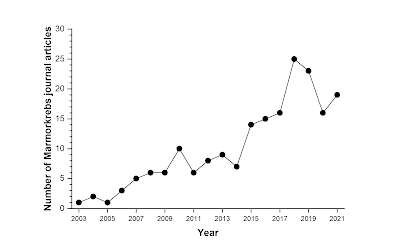
2021 was the third best year ever for Marmorkrebs research

Graph of number of Marmorkrebs journal articles from 2003 to 2021, with 19 papers in 2021.

At least it was the third best year as judged by number of journal articles. But there were more than just journal articles! At the start of the year, we had what was probably the best popular article written to date about Marmorkrebs.


It was a slow year for new introductions, but the one in Macau was a significant expansion in Asia.


And finally, I learned of two North American jurisdictions regulating Marmorkebs: Ohio, which seemed to have done it quietly in 2020, and Ontario, which did so quietly starting in 2022.


Previous year end reviews


2008 was the best year ever for Marmorkrebs research


2009 was tied for the best year ever in Marmorkrebs research


2010 was the best year ever for Marmorkrebs research


2011 was not the best year ever for Marmorkrebs research


2012 was an average year for Marmorkrebs research


2013 was the second best year ever for Marmorkrebs research


2014 was a good year for Marmorkrebs research


2015 was the best year ever for Marmorkrebs research


2016 was the best year ever for Marmorkrebs research


2017 was the second best year ever for Marmorkrebs research


2018 was the second best year ever for Marmorkrebs research


2019 was the second best year ever for Marmorkrebs research


2020 was not the best year for Marmorkrebs research


Ontario prohibits Marmorkrebs

Welcome to the Environmental Registry of Ontario.
The Gananoque Reporter reminds me of a story I have been watching for almost two years: Marmorkrebs have been added to a list of prohibited species in Ontario under the Invasive Species Act.


Marbled crayfish (Procambarus virginalis) and Louisiana red swamp crayfish (Procambarus clarkii) prohibited in Ontario, as of 1 January 2022. Happy new year. 


What does this mean in practical terms?


Prohibited species cannot be brought into Ontario, deposited, released, possessed or transported in Ontario and cannot be propagated, bought, sold or traded in Ontario.

The regulation includes species-specific exceptions to certain prohibitions, including: Marbled Crayfish, Red Swamp Crayfish: Exceptions allow for incidental capture of these species while fishing in Ontario.


This is a weird exemption, because as there are no marbled crayfish to be caught in Ontario, as far as I know.


This is the most significant regulation concerning marbled crayfish in North America to date, because Ontario is the largest and most populous jurisdiction that has yet tried to regulate marbled crayfish.


We’ll see if it works.


That I am just learning about this today – one day before it takes effect – emphasizes yet again how hard it is to keep track of this sort of legislation. I have alerts set for marbled crayfish and try to track this material as closely as possible. I am making an effort. But this passed me by for eight whole months.


Related posts 


Canadian province of Ontario asks for input on Marmorkrebs (February 2020)


Ontario seeks public comment on regulating marbled crayfish (April 2021)


External links


New Ontario boating rules Jan. 1 to stem spread of aquatic invasive species


Regulating 13 invasive species and watercraft as a carrier of invasive species under Ontario’s Invasive Species Act, 2015 (decision)


Regulating 13 invasive species and watercraft as a carrier of invasive species under the Ontario Invasive Species Act, 2015 (Analysis, April 2021)

02 December 2021

The newest version of Marmorkrebs.org

Marmorkrebs.org is moving to Google Sites.


https://sites.google.com/view/marmorkrebs/


One major advantage of this change is that Google Sites are much better at switching between desktop and mobile versions of the site, which will make people visiting by using their phones much happier!


Since its beginning, the main Marmorkrebs.org website has been hosted by my former employer, The University of Texas Rio Grande Valley (formerly The University of Texas Pan American). Last year, I took a new position. Because of that, I will soon be losing all access to the web hosting provided by that university.


I have updated the domain name pointers, so typing “marmorkreb.org” in your browser bar should now go to the new site. If, for some reason, you still need to visit the old, more complete site in the next couple of days, you can go to:


https://faculty.utrgv.edu/zen.faulkes/marmorkrebs/


Thank you!

23 November 2021

Captivity does not cause cloning

An >article about Marmorkrebs by Paul Hetzler is showing up in a wide array of places, from New York state to India. It’s generally accurate, although I have to raise eyebrows as to the description of the origin of Marmorkrebs.


Sometime in the 1990s, a mutant crayfish able to conquer and degrade aquatic systems emerged as a result of secret German experiments gone awry. (What the what? - ZF) The marmorkreb (sic), a.k.a. marbled crayfish (Procambarus virginalis), is a destructive new species that first appeared aquariums in Germany. However, it’s more likely the result of too much inbreeding in captivity, rather than some mad-scientist scheme, that led to their mutation.


I think – I hope – Hetzzler meant the bit about “secret experiments” as a joke. I am willing to be that some people will take it as real and won’t make ti to the second part of the paragraph. But the second part of the paragraph is also pretty dubious. 


There is no evidence that inbreeding can cause triploidy. Inbreeding increases homozygosity. It doesn't create extra chromosomes, particularly a whole new set of chromosomes.


By weird coincidence, a technical paper in press also seems to think that just being in captivity is enough to make a species parthenogenetic.


The marbled crayfish Procambarus virginalis probably evolved clonal parthenogenetic reproduction while in the captive aquarium trade. ... With growth in human cultivation of invertebrates for food and other services, the potential for evolution and escape into the wild and subsequent rapid spread of other clonal species is increasing.


This stands in contrast to a recent paper by Gutekunst and colleagues that argues that there are triploid individuals in the natural slough crayfish population, from which Marmorkrebs ultimately emerged.


We need to stop with this narrative that somehow the origin of Marmorkrebs in humans’ fault. It’s not as though there is a shortage of crayfish guilt in the world. It’s our fault we spread them around the globe. That’s on us.


Hetzler also mentions a controversy that... I don’t think exists?


Perhaps the only amusing thing about these nasty aberrations of nature is the mild squabbling as to how one should describe them. Experts disagree on whether the new organisms are mottled, freckled, speckled, spotted, variegated, or something else.


I have never seen a single written comment arguing about what to call the pattern on Marmorkrebs.


Update, 2 December 2021: Yet another article implies that “captivity is to blame for asexual reproduction:


Some insects and other invertebrates have evolved a novel solution to the “can’t get a date” problem: They can reproduce without sex. ... At least one invertebrate, the marbled crayfish, evolved the ability to reproduce asexually in captivity and is now spreading rapidly across Europe, Africa and Asia, carrying with it disease that harms native species. As we cultivate other invertebrates for food or hobbies, we raise the risk that something similar might happen with other species.


I say again: just the act of keeping a species in a tank does not increase the chance of it becoming parthenogentics. It increases the chance we notice it.


Update, 31 December 2021: Even The Guardian gets in on the act by reprinting the Ensia article.


References


Gutekunst J, Maiakovska O, Hanna K, Provataris P, Horn H, Wolf S, Skelton CE, Dorn NJ, Lyko F. 2021. Phylogeographic reconstruction of the marbled crayfish origin. Communications Biology 4(1): 1096. https://doi.org/10.1038/s42003-021-02609-w


Sutherland WJ, Atkinson PW, Butchart SHM, Capaja M, Dicks LV, Fleishman E, Gaston KJ, Hails RS, Hughes AC, Le Anstey B, Le Roux X, Lickorish FA, Maggs L, Noor N, Oldfield TEE, Palardy JE, Peck LS, Pettorelli N, Pretty J, Spalding MD, Tonneijck FH, Truelove G, Watson JEM, Wentworth J, Wilson JD, Thornton A. 2021. A horizon scan of global biological conservation issues for 2022. Trends in Ecology & Evolution: In press. https://doi.org/10.1016/j.tree.2021.10.014


External links


Marbled Crayfish: The Mutants Have Landed


Help keep marbled crayfish from spreading


The Mutants Have Landed


Horizon scan: the opportunities and threats facing Earth’s biodiversity

05 November 2021

Chucholl and Chucholl 2021

Cover of Freshwater Biology, volume 66, issue 11.
Chucholl F, Chucholl C. 2021. Differences in the functional responses of four invasive and one native crayfish species suggest invader-specific ecological impacts. Freshwater Biology 66(11): 2051-2063. https://doi.org/10.1111/fwb.13813


Abstract


  1. Invasive non-native species represent a leading threat to global freshwater biodiversity and non-native crayfish species frequently cause extensive ecological damage. However, the extent to which their impact: (1) depends on invader identity and (2) differs from the natural state with native crayfish remains unclear. Comparison of the functional responses of invasive and native species represents a promising approach in this regard.
  2. Here, we explored whether four invasive crayfish species (calico crayfish Faxonius immunis, spiny-cheek crayfish Faxonius limosus, signal crayfish Pacifastacus leniusculus, and marbled crayfish Procambarus virginalis) in European freshwaters and the most widespread native species (noble crayfish Astacus astacus) overlap in function in their potential effects on key resources of benthic food webs. First, the impact on gammarids and zebra mussels was assessed by means of comparative functional response analysis using the functional response ratio as impact metric; second, the consumption of macrophytes (Chara sp.) and detritus (leaf litter) was quantified and compared using feeding experiments.
  3. Both invader- and resource-specific effects were observed. Invasive calico crayfish and signal crayfish exhibited the strongest per capita effects on gammarids and zebra mussels, respectively, with functional response ratios being 2-fold higher than those of native noble crayfish. Marbled crayfish showed an intermediate effect on both prey species, whereas spiny-cheek crayfish had lower impacts than noble crayfish. In the feeding experiment, calico crayfish consumed the highest amount of detritus, while the consumption of macrophytes did not differ among the five crayfish species.
  4. Our work demonstrates as-yet unrecognised differences in functional responses among the four North American crayfish invaders and the European noble crayfish. The lack of congruence across the observed impacts suggests a mostly species-specific pattern and stresses the importance of species and resource identity when considering the ecological impact of crayfish. An initial assessment of invader-specific potential impacts positions calico crayfish and signal crayfish among the most impactful invaders.

Keywords: ecological impact • ecological redundancy • functional response • invasive crayfish risk assessment

Open access.


Scholz and colleagues 2021

Zoomorphology journal cover
Scholz S, Göpel T, Richter S, Wirkner CS. 2021. High degree of non-genetic phenotypic variation in the vascular system of crayfish: a discussion of possible causes and implications. Zoomorphology 140: 317-329. https://doi.org/10.1007/s00435-021-00536-2


Abstract


In this study, the hemolymph vascular system (HVS) in two cambarid crayfishes, i.e. the Marbled Crayfish, Procambarus virginalis Lyko, 2017 and the Spiny Cheek Crayfish, Faxonius limosus (Rafinesque, 1817), is investigated in regard of areas of non-genetic phenotypic variation. Despite their genetic identity, specimens of P. virginalis show variability in certain features of the HVS. Thus, we describe varying branching patterns, sporadic anastomoses, and different symmetry states in the vascular system of the marbled crayfish. We visualize our findings by application of classical and modern morphological methods, e.g. injection of casting resin, micro-computed tomography and scanning electron microscopy. By comparing our findings for P. virginalis to the vasculature in sexually reproducing crayfishes, i.e. F. limosus and Astacus astacus, we discuss phenotypic variation of the HVS in arthropods in general. We conclude that constant features of the HVS are hereditary, whereas varying states identified by study of the clonal P. virginalis must be caused by non-genetic factors and, that congruent variations in sexually reproducing F. limosus and A. astacus are likely also non-genetic phenotypic variations. Both common causal factors for non-genetic phenotypic variation, i.e., phenotypic plasticity and stochastic developmental variation are discussed along our findings regarding the vascular systems. Further aspects, such as the significance of non-genetic phenotypic variation for phylogenetic interpretations are discussed.


Keywords: Evolutionary morphology • phenotypic plasticity • circulatory system • heart • artery

Open access logo.


01 November 2021

Celbrate diversity: Charasmatic California condors can without consumation

California condor in flight


It’s been fascinating to watch species that have been well studied suddenly and unexpectedly show that they can reproduce by parthenogenesis. The latest entry to the club is perhaps the most surprising yet: the critically endangered California condor.


The story is making the rounds on science news, but the original technical article is here.


Two males were generated by parthenogenesis. This is in contrast to many other cases of parthenogenesis, where offspring are exclusively female. Birds have a ZW chromosome system, where the females have different sex chromosomes. The males have two of the same sex chromosome. I suppose that in theory, the condors could produce offspring of either sex by parthenogenesis?


References


Ryder OA, Thomas S, Judson JM, Romanov MN, Dandekar S, Papp JC, Sidak-Loftis LC, Walker K, Stalis IH, Mace M, Steiner CC, Chemnick LG. Facultative parthenogenesis in California condors. Journal of Heredity: In press. https://doi.org/10.1093/jhered/esab052


External links


After 30 Years of Breeding Condors, a Secret Comes Out