Showing posts with label publishing. Show all posts

31 December 2024

2024 was a decent year for Marmorkrebs research

It’s time for our annual* tradition to look at the trendlines for marbled crayfish research...


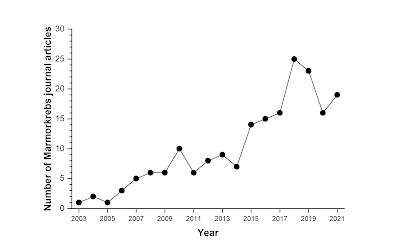
A graph plotting number of Marmorkrebs journal articles every years since 2003, generall increasing until 2018 and generally decreasing since.


I can’t say that I am super excited by what seems to be a new normal for Marmorkrebs research. There is a stronger need for research than ever, given that the number of countries with introduced Marmorkrebs just keeps growing. South Korea was added to the map of countries with confirmed introductions (although the discovery was a while back).


Meanwhile, Minnesota banned Marmorkrebs. And I am concerned that these bans are not having any exemptions for bona fide scientific research.

Previous year end reviews

2008 was the best year ever for Marmorkrebs research

2009 was tied for the best year ever in Marmorkrebs research

2010 was the best year ever for Marmorkrebs research

2011 was not the best year ever for Marmorkrebs research

2012 was an average year for Marmorkrebs research

2013 was the second best year ever for Marmorkrebs research

2014 was a good year for Marmorkrebs research

2015 was the best year ever for Marmorkrebs research

2016 was the best year ever for Marmorkrebs research

2017 was the second best year ever for Marmorkrebs research

2018 was the second best year ever for Marmorkrebs research

2019 was the second best year ever for Marmorkrebs research

2020 was not the best year for Marmorkrebs research

2021 was the third best year ever for Marmorkrebs research

2022 was a slow year for Marmorkrebs research


* Except 2023. Sorry. Missed that one.

31 December 2022

2022 was a slow year for Marmorkrebs research

 This is usually a more optimistic exercise for me.

Graph of publications about Marmorkrebs from 2003 to 2022, with peak in 2018.

After years of being able to write that “This was the best year ever,” the last five years show a downward trend in the number of research publications on Marmorkrebs. This graph shows only journal articles, and excludes one interesting article in Crayfish News. Still, even if I included that, this is the least active year in 6 or 7 years.


This may be because some of the original research questions about Marmorkrebs – their origin and basic biology – are now resolved. It may also be that because this species is more widespread, new records of introductions are less likely to be reported or published.


The biggest story this year was the expanding use of local legislation to ban or regulate the sale of Marmorkrebs in the pet trade. Someone was actually charged under a law for selling Marmorkrebs for the first time. Ontario and Georgia banned Marmorkrebs, and Minnesota is thinking about it.The Ontario ban is quite significant, given the size and population of the province.


Previous year end reviews

2008 was the best year ever for Marmorkrebs research

2009 was tied for the best year ever in Marmorkrebs research

2010 was the best year ever for Marmorkrebs research

2011 was not the best year ever for Marmorkrebs research

2012 was an average year for Marmorkrebs research

2013 was the second best year ever for Marmorkrebs research

2014 was a good year for Marmorkrebs research

2015 was the best year ever for Marmorkrebs research

2016 was the best year ever for Marmorkrebs research

2017 was the second best year ever for Marmorkrebs research

2018 was the second best year ever for Marmorkrebs research

2019 was the second best year ever for Marmorkrebs research

2020 was not the best year for Marmorkrebs research

2021 was the third best year ever for Marmorkrebs research


31 December 2021

2021 was the third best year ever for Marmorkrebs research

Graph of number of Marmorkrebs journal articles from 2003 to 2021, with 19 papers in 2021.

At least it was the third best year as judged by number of journal articles. But there were more than just journal articles! At the start of the year, we had what was probably the best popular article written to date about Marmorkrebs.


It was a slow year for new introductions, but the one in Macau was a significant expansion in Asia.


And finally, I learned of two North American jurisdictions regulating Marmorkebs: Ohio, which seemed to have done it quietly in 2020, and Ontario, which did so quietly starting in 2022.


Previous year end reviews


2008 was the best year ever for Marmorkrebs research


2009 was tied for the best year ever in Marmorkrebs research


2010 was the best year ever for Marmorkrebs research


2011 was not the best year ever for Marmorkrebs research


2012 was an average year for Marmorkrebs research


2013 was the second best year ever for Marmorkrebs research


2014 was a good year for Marmorkrebs research


2015 was the best year ever for Marmorkrebs research


2016 was the best year ever for Marmorkrebs research


2017 was the second best year ever for Marmorkrebs research


2018 was the second best year ever for Marmorkrebs research


2019 was the second best year ever for Marmorkrebs research


2020 was not the best year for Marmorkrebs research


31 December 2020

2020 was not the best year for Marmorkrebs research

As if there weren’t enough reasons to hate 2020, the number of Marmorkrebs papers published was down from the last two years.


Graph showing journal articles about Marmorkrebs from 2003 to 2020.


It’s impossible to tell if the dip in number of publications is the result of a global pandemic or just the regular up and down you see in these sorts of data.


Marmorkrebs did make international news again this year, mainly because a cloning crayfish invading a cemetery is a great story for Halloween. That was the first record of Marmorkrebs in Belgium, but another first record – on the island of Taiwan – made for fewer news stories but may have been more important in showing how Marmorkrebs are spreading globally.


On the legislative front, Marmorkrebs (and other crayfish) were banned in Japan, the American state of Michigan, and the Canadian province of Saskatchewan. Several jurisdictions like North Carolina and Ontario are considering following suit.


Update, 4 January 2021: Have just found another paper with a 2020 release (Stein and colleagues, 2020), so the count shown in the graph is one too low.


Related posts


2008 was the best year ever for Marmorkrebs research

2009 was tied for the best year ever in Marmorkrebs research

2010 was the best year ever for Marmorkrebs research

2011 was not the best year ever for Marmorkrebs research

2012 was an average year for Marmorkrebs research

2013 was the second best year ever for Marmorkrebs research

2014 was a good year for Marmorkrebs research

2015 was the best year ever for Marmorkrebs research

2016 was the best year ever for Marmorkrebs research

2017 was the second best year ever for Marmorkrebs research

2018 was the second best year ever for Marmorkrebs research

2019 was the second best year ever for Marmorkrebs research

06 January 2020

2019 was the second best year ever for Marmorkrebs research

I am a little late, but the tradition continues!


This is a conservative estimate of the research activity around Marmorkrebs, because it only includes journal articles, not doctoral theses or the Forum Flusskrebse articles and the like.

As with previous years, the articles are roughly evenly split between interest in Marmorkrebs as a lab animal used for basic research, and Marmorkrebs as an potential or actual invasive species. And indeed, reports emerged (not yet published) of Marmorkrebs in three more countries: France, Denmark, and Israel. The latter is the first report from the Middle East.

Like their introductions into natural ecosystems, the research trendline shows no signs of slowing down.

Update, 14 January 2020: Another paper came out with a 2019 cover date, so the graph is now updated!


Related posts

2008 was the best year ever for Marmorkrebs research
2009 was tied for the best year ever in Marmorkrebs research
2010 was the best year ever for Marmorkrebs research
2011 was not the best year ever for Marmorkrebs research
2012 was an average year for Marmorkrebs research
2013 was the second best year ever for Marmorkrebs research
2014 was a good year for Marmorkrebs research
2015 was the best year ever for Marmorkrebs research
2016 was the best year ever for Marmorkrebs research
2017 was the second best year ever for Marmorkrebs research
2018 was the second best year ever for Marmorkrebs research

31 December 2018

2018 was the second best year ever for Marmorkrebs research

It’s time for this blog’s longest running tradition! (Okay, the only tradition, if we’re honest.) It’s the eleventh annual look at trends in Marmorkrebs publishing!


As mentioned back in 2016, the graph above includes journal articles and book chapters. There were no book chapters this year, however. I feel compelled to add a second graph, plotting only the journal articles. The graph below is much more what this year felt like:


A barnstormer of a bumper crop of a year that was much busier than any before. But 2016 comes out on top because a single book dropped with a bunch of articles on Marmorkrebs. But several of those were reviews, and that they all came out in one volume meant it felt like one event instead of nine. Honestly, I think the activity in Marmorkrebs papers coming out in journals is a better indicator of the expansion of the field.

This year saw the biggest Marmorkrebs paper of all time published, at least as measured by its Altmetric score. Gutekunst and colleagues had two major findings in one paper:

  1. Announcing the sequencing of the Marmorkrebs genome, the first for a decapod crustacean.
  2. Documenting the spread of Marmorkrebs in Madagascar since their detection about a decade earlier.

What was strange, though, was that almost none of the news coverage (of which there was a lot) focused on either of those two things. Most focused on the fact that cloning crayfish were a thing, which we have known from 2003. Some focused on the invasive nature of Marmorkrebs, but tended to talk about their spread in Europe rather than Madagascar. Having the first decapod crustacean genome, which might have been the biggest long term result from this paper, was very underplayed.

Another trend was researchers started to adopt the name Procambarus virginalis, after the name was proposed three years ago. The initial 2015 proposal was a “naked name” (nomen nuden in taxonomic lingo) with none of the typical descriptive work to accompany the new Linnean name, and the community generally used Procambarus fallax forma virginalis in 2016 and 2017. But having a proper taxonomic paper published in 2017 seems to have turned the tide, and P. virginalis seems to now be the accepted name in the community.

With the trendline continuing to head up, and two papers with 2019 cover dates already out, the state of Marmorkrebs research is strong.

Related posts

2008 was the best year ever for Marmorkrebs research
2009 was tied for the best year ever in Marmorkrebs research
2010 was the best year ever for Marmorkrebs research
2011 was not the best year ever for Marmorkrebs research
2012 was an average year for Marmorkrebs research
2013 was the second best year ever for Marmorkrebs research
2014 was a good year for Marmorkrebs research
2015 was the best year ever for Marmorkrebs research
2016 was the best year ever for Marmorkrebs research
2017 was the second best year ever for Marmorkrebs research

31 December 2017

2017 was the second best year ever for Marmorkrebs research

This is an annual tradition here on the Marmorkrebs blog! It’s fun to make this graph longer and longer every year...


In terms of straight journal articles, 2017 was tied with 2016: fifteen each. There was just no book dropping a set of chapters to lift the total like last year

There were some significant papers this year. There was a proposal to elevate Marmorkrebs to its own species. Part of this included deposition of reference specimens in a museum, which should be a useful long-term resource, regardless of whether the community moves to the proposed new species name, Procambarus virginalis.

The number of introduced populations continued to increase, with more reports in the scientific literature of European locations and newspaper reports of more discoveries in Japan.

And perhaps most excitingly for next year, there were several doctoral theses that will hopefully become publications in the near future. Maybe even 2018! (One paper, by Císař and others, has already been published with a 2018 publication date.)

The overall trendline still shows no sign of flattening.

Related posts

2008 was the best year ever for Marmorkrebs research
2009 was tied for the best year ever in Marmorkrebs research
2010 was the best year ever for Marmorkrebs research
2011 was not the best year ever for Marmorkrebs research
2012 was an average year for Marmorkrebs research
2013 was the second best year ever for Marmorkrebs research
2014 was a good year for Marmorkrebs research
2015 was the best year ever for Marmorkrebs research
2016 was the best year ever for Marmorkrebs research

06 February 2017

Call for crustacean papers: Fishes


Even though I have been a working professional scientist for some time, there are always more journals than time, so I am always on the lookout for journals that would be appropriate for Marmorkrebs papers.

When I first saw the journal Fishes, I though, “This is not for me, because I don’t study animals with backbones.” But despite the title, Fishes takes papers on invertebrates, too. The journal’s mandate includes “aquatic life science and aquatic animals (fishes, molluscs and crustaceans, both fresh water and marine).”

Fishes caught my eye for a few reasons.

It is a new journal, it is open access, and they are waiving article processing charges for articles published in 2017. Given that the main reason I see people not publishing open access is that people are unable to pay article processing fees, offering free publication as an “introductory offer,” as it were, is interesting to many researcher.

That said, while this journal doesn’t have much of a track record yet, the publisher, MDPI, has a mixed track record at best.

In brief, on the negative column, MDPI journals have published several very poor papers. They have also sent out a lot of unsolicited emails (this post was prompted by one).

On the positives column, MDPI is a member of the Directory of Open Access Journals and the Committe on Publication Ethics. The Fishes editor-in-chief appears to be a real person. Richard Poynder has a thorough article and interview from 2015 covering the debates about whether the Fishes publisher could be rightfully called a “predatory publisher.” Scammers are typically not as transparent as MDPI owner Shu-Kun Lin is in this interview, although some of his answers give me pause.

And publishing articles for free – as Fishes is doing this year – would be an incredibly bad scam.

External links

Fishes
The Open Access Interviews: Publisher MDPI
Is MDPI a reputable Academic Publisher?

31 December 2016

2016 was the best year ever for Marmorkrebs research

And it was the best by a long, long ways.

There are not only more papers, but they are coming from more places, too. In the early 2000s, papers were almost exclusively from western Europe and particularly Germany. Now, eastern Europe and Japan are regularly publishing Marmorkrebs papers in addition to the more established western European and American research programs. And the mix of papers is broad, too, with research on Marmorkrebs as invasive species, cellular biology, and behaviour.

Since I started this blog, it’s been a tradition for me to have a graph showing how many papers on Marmorkrebs were published compared to previous years. But making this year’s graph was trickier than before, because there are more kinds of research products out there than before.

In the past, I’ve included journal articles and book chapters. But by this year, I’ve been blogging pre-prints, master’s theses, and conference abstracts in addition to regular old articles and chapters. I’ve thought about whether to include these research products, and decided to include journal articles and book chapters only. In theory, pre-prints and master’s theses should be published later, so excluding them avoids the problem of inflating the publication rates.

As I noted last year, I also had the confusion of a book published in 2015 that had a 2016 cover date (Freshwater Crayfish, which I was involved with). Those book chapters are included in 2016, which bumps up the total for the year considerably. But 2016 would still be the best year ever for Marmorkrebs research even if if you removed the seven Freshwater Crayfish chapters from the total.

The book publication does mean that it will be hard for 2017 to top 2016 in the number of crayfish papers. The overall trend, however, shows no signs of flattening.


Related posts

2008 was the best year ever for Marmorkrebs research
2009 was tied for the best year ever in Marmorkrebs research
2010 was the best year ever for Marmorkrebs research
2011 was not the best year ever for Marmorkrebs research
2012 was an average year for Marmorkrebs research
2013 was the second best year ever for Marmorkrebs research
2014 was a good year for Marmorkrebs research
2015 was the best year ever for Marmorkrebs research

08 December 2016

Call for crustacean papers: The Journal of Crustacean Biology

Journal of Crustacean Biology is well established, peer-reviewed journal published by The Crustacean Society. But there are changes afoot!

The journal is moving over to Oxford University Press at the start of the new year (Volume 37, Number 1). The journal will be getting a new format (presumably in line with other Oxford University Press journals like Integrative and Comparative Biology), colour covers, and will have an open access option – I think for the first time for the journal.

Society members pay no page charges, will get reduced open access fees, and free access to the Journal’s digital archive. Plus, society members will a 25% discount on Oxford University Press books. Given the cost of academic books, it will only take a few book purchases to make membership in the Society pay for itself!

Current editor-in-chief Peter Castro encourages the submission of review articles, short research notes, and articles on techniques and methods. You can email him for the new author’s instructions.

The journal has published several Marmorkrebs papers already (Kawai et al. 2009; Martin & Scholz 2012; Shinji et al. 2016), so hopefully it will publish more Marmorkrebs papers there under the auspices of the new publisher!


External links

Journal of Crustacean Biology
The Crustacean Society website

06 December 2016

Call for crustacean papers: Nauplius


Nauplius is a peer-reviewed, open access journal published by Sociedade Brasileira de Carcinologia, also known as the Brazilian Crustacean Society. Its mandate is to cover all aspects of crustacean biology. It has clocked up a more than 20 year track record, but, like so many fine regional journals, was new to me (embarrassingly 😔).

Because it is sponsored by the Society, there are no article processing fees for publishing in the journal. Remember this journal for the next time someone says, “But I can’t afford to publish open access.” Really? You can’t afford free?

The new feature of this journal is that they have moved to a continuous publication model, Papers are available online shortly after acceptance, rather than being held back for the delivery of a bundled issue.

It might be a good venue to submit research on Marmorkrebs!


External links

Nauplius website
Nauplius on Facebook

26 July 2016

Incoming: Biology and Ecology of Crayfish

A new crayfish book is out! Biology and Ecology of Crayfish has ten chapters of freshwater crustacean goodness. Marmorkrebs make a few cameo appearances in chapters marked with an asterisk.

  1. Taxonomy and identification. 
  2. Population genetics of crayfish: endangered and invasive species. *
  3. Crayfish growth and reproduction. *
  4. Behavior of freshwater crayfish. 
  5. Chemical ecology of crayfish. 
  6. Parasites, commensals, pathogens and diseases of crayfish. *
  7. Environmental drivers for population success: population biology, population and community dynamics. *
  8. Sampling techniques for crayfish. 
  9. Laboratory methods for crayfish studies. 
  10. The management of invasive crayfish. *

External links

Biology and Ecology of Crayfish (Publisher website)

31 December 2015

2015 was the best year ever for Marmorkrebs research

Back at the close of 2010, I made a prediction: that 2015 would see fourteen papers published on Marmorkrebs. How did I do? Here’s this blog’s traditional annual publication graph:


Coming into this last week of the year, I was worried, but a last minute publication helped me shame Nostradamus.

Being an academic, I must now add the caveats and qualifiers about my nailing it.

For this annual graph, I normally count peer reviewed journal articles and book chapters published during the year. But this year, there were a few new wrinkles. There were a bunch of book chapters in Freshwater Crayfish: A Global Overview that were published this year, but the book consistently gives its publication date as 2016 throughout. So I left those out, meaning we have a good head start on 2016 publications. I also left out a pre-print that came out later as a paper (no double dipping!) and some conference abstracts.

Not only were there more Marmorkrebs papers than ever, there was several notable ones.

We had two independent confirmations that Marmorkrebs were triploid organisms (one published, one in press), with one of the highest chromosome counts in the animal kingdom.

There was the first Marmorkrebs paper from a Japanese lab, with some interesting research on masculinizing Marmorkrebs.

There were several papers on the spread and risk assessment of Marmorkrebs and their prospects as disease vectors.

And there was the proposal that Marmorkrebs be given a new species name, Procambarus virginalis. I’ll be watching this one with interest to see if the community adopts the suggested new name. This is why I like “Marmorkrebs” as an informal name for these crayfish: it stays intact when formal taxonomic names change!

I’m feeling emboldened by this year’s successful prediction. But back in 2010, I also predicted there will be twenty papers in 2020. One should always revise predictions in the light of new data, however. Now that there are five more data points, the prediction machine (also known as a simple linear fit to the data) estimates that there will be sixteen Marmorkrebs papers published in 2020.

Place your bets, and I’ll meet you here in five years to find out.

Related posts

2008 was the best year ever for Marmorkrebs research
2009 was tied for the best year ever in Marmorkrebs research
2010 was the best year ever for Marmorkrebs research
2011 was not the best year ever for Marmorkrebs research
2012 was an average year for Marmorkrebs research
2013 was the second best year ever for Marmorkrebs research
2014 was a good year for Marmorkrebs research

20 October 2015

Cover girl

Look down in the lower left corner!


Marmorkrebs are featured on the cover, and will likely feature repeatedly in this forthcoming book. The table of contents lists a section titled, “Parthenogenesis. Obligatory and facultative. Cyclic. Geographic.”

Hat tip to Günter Vogt.

External links

Reproduction and Development of Crustacea

07 October 2015

Pre-print power


Pre-prints are, of course, yesterday’s news in some circles. They are nothing new for the physics community, which has been using the arXiv pre-print server for more than two decades now. Several fields, including biology, have been reluctant to follow that trail. There is still a lot to talk about with pre-prints.

Pre-prints have been in the news a little more than usual lately, with a string of articles and editorials and blog posts about the potential benefits for pre-prints. (List of recent links at the bottom.) They’ve also been on my mind since a recent manuscript by Vogt and colleagues was the first in the Marmorkrebs research community to go up on a pre-print server, BioRxiv.

I asked two of the authors about what motivated their decision to post a pre-print, and how they thought this worked out for them.

Frank Lyko wrote:

We were a bit frustrated by the reviewing process. It takes time as it often takes some unexpected twists and turns. Also, it’s not uncommon that reviews or editorial decisions are completely off the mark. Posting provides you with an opportunity to let the community be the judge and not worry about the hidden agendas of reviewers or editors.

We wanted this story to be out in the open. Peer review can take an inordinate amount of time. BioRxiv promises to be fast, and indeed, 5 hours(!) after the initial submission, the screening process was completed. The paper was then instantly posted with a doi and thus became a citable reference.

And another point (even if it was not relevant in our case). The publication fees for some of the good journals now amass to several thousand euros. We are usually in the €5000 range if we want to include open access, which is egregious. BioRxiv posting is for free.

Günter Vogt wrote:

In the days after posting one of the staff writers of Science came across the paper and wrote a small article for the Science News. This small article was then discussed in the net and we have addressed some of the critical issues in our final paper in Biology Open, for example, the important question when a parthenogenetic lineage should be considered as an independent species and when not. The abstract of the BioRxiv version was clicked 1627 times already and the full paper was downloaded 666 times. This is a quite good distribution of knowledge in six weeks.

bioRxiv is still a developing resource. The site  recently started showing tweets about the paper. While more people are posting to the site (right), though, the number is a tiny fraction of biological publishing. This page indicates over 806,636 articles were added to PubMed in 2013, which works out to 67,000 papers a month. A couple of hundred bioRxiv papers per month pales in comparison.

As noted in the quotes above, the manuscript by Vogt and colleagues has been accepted for publication in a standard journal. I will be interested to see if interest in journal article tracks that of the pre-print. My own experience, with the PeerJ pre-print server, has been that while pre-prints are nice, the final journal article gets more attention.

References

Desjardins-Proulx P, White EP, Adamson JJ, Ram K, Poisot T, Gravel D. 2013. The case for open preprints in biology. PLOS Biology 11(5): e1001563. http://dx.doi.org/10.1371/journal.pbio.1001563

Pennisi E. 2015. Crayfish create a new species of female ‘superclones’. Science News ScienceShots. http://dx.doi.org/10.1126/science.aad1673

Shuai X, Pepe A, Bollen J. 2012. How the scientific community reacts to newly submitted preprints: article downloads, Twitter mentions, and citations. PLOS ONE 7(11): e47523. doi:10.1371/journal.pone.0047523

External links

Peer review, preprints and the speed of science
A PeerJ PrePrint – so just what is that exactly?
Preprints in paleontology: really that radical?
Preprints in science
Accelerating Scientific Publication in Biology
Four different reasons to post preprints
The science of asking

28 January 2015

Call for crustacean papers: Crustacean Research

Crustacean Research is a peer-reviewed, open access journal that covers all fields of biology of crustaceans and their related taxa. This journal has been running for some time, but it is new to me. The former president of The Crustacean Society, Akira Asakura, is editor-in-chief.

The publication costs are quite reasonable for an open access journal. People who are not members of the Carcinological Society of Japan pay about US$30 per page if there is no colour on the page. $300 for a ten page paper compares very favourably to, say, PLOS ONE ($1,350).

It might be a good venue to submit research on Marmorkrebs!

01 January 2015

2014 was a good year for Marmorkrebs research

Continuing our annual tradition here on this blog...

Although slightly down from last year, the overall trendline for Marmorkrebs publications still appears to be increasing.

A few highlights of this year include the long expected confirmation that Marmorkrebs can be vectors of crayfish plague, and still more individuals found in the wild in Europe. Next year should be a big one, with the forthcoming Freshwater Crayfish: A Global Overview providing longer treatments of topics concerning Marmorkrebs.

12 August 2014

First look at Freshwater Crayfish: A Global Overview


A new book on crayfish is now up at the publisher’s website. Here is the publisher’s description, with my emphasis added:

Features

  • Provides an up-to-date reference work on commercially important crustaceans
  • Covers conservation status and biology of all endangered species, taxonomy, and distribution of crayfishes worldwide
  • Introduces a new model aquatic organism—a parthenogenetic freshwater crayfish

Summary

For their great commercial importance as a human food delicacy, crayfish are now becoming of wider interest to molecular biologists, and also to conservationists due to the fact that in some countries many of the native crayfish species are under threat from human activity, disease, and competition from other introduced crayfish species. Helmed by three editors in Japan, Europe, and the US, this book invites contributions from experts around the globe, covering the conservation status and biology of all endangered species, taxonomy, and distribution of crayfishes worldwide

It is slated for publication 15 April 2015.

01 January 2014

2013 was the second best year ever for Marmorkrebs research

Continuing an annual tradition here on the Marmorkrebs blog, we look back at what the year brought in Marmorkrebs research...


The increase in papers may be slow, but an increase it is. I like the trend...

02 May 2013

The Ecdysiast feature

The newest issue of The Crustacean Society’s newsletter, The Ecdysiast, is now available for viewing here. There are several articles of interest for readers. One is coverage of the SICB crayfish symposium that occurred in January It includes a note of the untimely death of Francesca Gherardi.

Also of interest are articles by Fred Schram, the general editor for the Journal of Crustacean Biology. In particular, “To be open or not to be open: That is the question” (page 7) is a look at open access from the perspective of someone in the thick of trying to maintain a journal in the face of a changing market, which includes declining Society membership.

Is OA the wave of the future? – maybe. However, we might suggest that “efficient” application of the OA model will lead to the collapse of many journals, especially those produced by small scholarly societies.

(Plug: If you are interested in crustacean biology, you should join the Society!)