Showing posts with label parthenogenesis. Show all posts

01 November 2021

Celbrate diversity: Charasmatic California condors can without consumation

California condor in flight


It’s been fascinating to watch species that have been well studied suddenly and unexpectedly show that they can reproduce by parthenogenesis. The latest entry to the club is perhaps the most surprising yet: the critically endangered California condor.


The story is making the rounds on science news, but the original technical article is here.


Two males were generated by parthenogenesis. This is in contrast to many other cases of parthenogenesis, where offspring are exclusively female. Birds have a ZW chromosome system, where the females have different sex chromosomes. The males have two of the same sex chromosome. I suppose that in theory, the condors could produce offspring of either sex by parthenogenesis?


References


Ryder OA, Thomas S, Judson JM, Romanov MN, Dandekar S, Papp JC, Sidak-Loftis LC, Walker K, Stalis IH, Mace M, Steiner CC, Chemnick LG. Facultative parthenogenesis in California condors. Journal of Heredity: In press. https://doi.org/10.1093/jhered/esab052


External links


After 30 Years of Breeding Condors, a Secret Comes Out

22 December 2020

Parthenogenesis 2020 stories

Christmas – or, as we crustacean researchers like to call it, Crustmas – is one of the best times of year to talk about Marmorkrebs, because many interested in the idea of virgin birth at this time of year.


No idea why. 😉


Here are a couple of good articles about parthenogenesis making the rounds this holiday season.


Virgin births from parthenogenesis: How females from some species can reproduce without males: I can’t help but wonder if this article from The Conversation may have inspired the SyFy article below, given that both feature Asian water dragons at the top of the page. No Marmorkrebs.


Some unnatural creatures can replicate themselves without even trying, no mate required: This SyFy Wire piece looses points for calling parthenogenesis shaming in the title and no Marmorkrebs. Otherwise pretty good.


P.S.—Sadly, about that Asian water dragon? It has joined its ancestors in the great beyond.

12 May 2020

Celebrate diversity: All females, all prawns

Ars Technica has a big feature article on all female crustaceans being used for food, but it’s not Marmorkrebs.

Marmorkrebs are being used as food in Madagascar (see Andriantsoaet al. 2019, 2020) and there is interest in developing them for commercial aquaculture (Jurmalietiset et al. 2019), but there is not much of an existing market for crayfish this small.

Freshwater prawns (Macrobrachium rosenbergii) are another matter. They are widely cultivated and harvested for food in many countries. There was a challenge on The Amazing Race (American version, Season 31, Episode 3) where teams caught them from an indoor fishing center in Vietnam.


I hadn’t been paying close attention to a company called Enzootic that has created a way of making prawns all female. Unlike Marmorkrebs, which are genetically distinct, this company takes advantage of plasticity in sex determination in this species:

It starts by surgically extracting the hormone-producing organ from “donor” males, which are then broken down into individual cells. When the cells are injected into young females, the hormones they produce cause the females to develop as males, despite their chromosomes. Just like natural male prawns, they can mate normally with other females, but some of their offspring possess a unique trait. Known as “super females,” they produce offspring that will develop as females regardless of the chromosomes they carry.

Enzootic has set up the genetics of its shrimp so that these super females are relatively easy to identify, and they can be used to quickly produce large populations of nothing but females.

Some technical papers on this process are Sagi and Aflalo (2005) Mohanakumaran et al. (2006), and Levy et al. (2017).

References

Andriantsoa R, Jones JPG, Achimescu V, Randrianarison H, Raselimanana M, Andriatsitohaina M, Rasamy J, Lyko F. 2020. Perceived socio-economic impacts of the marbled crayfish invasion in Madagascar. PLOS ONE 15(4): e0231773. https://doi.org/10.1371/journal.pone.0231773

Andriantsoa R, Tönges S, Panteleit J, Theissinger K, Carneiro VC, Rasamy J, Lyko F. 2019. Ecological plasticity and commercial impact of invasive marbled crayfish populations in Madagascar. BMC Ecology 19(1): 8. https://doi.org/10.1186/s12898-019-0224-1

Jurmalietis R, Grickus A, Elstina A. 2019. Marbled crayfish (Procambarus virginalis) as a promising object for aquaculture industry. In: Environment. Technology. Resources. Proceedings of the 12th International Scientific and Practical Conference, Volume 1, pp. 92-95. http://dx.doi.org/10.17770/etr2019vol1.4174

Levy T, Rosen O, Eilam B, Azulay D, Zohar I, Aflalo ED, Benet A, Naor A, Shechter A, Sagi A. 2017. All-female monosex culture in the freshwater prawn Macrobrachium rosenbergii – A comparative large-scale field study. Aquaculture 479: 857-862. https://doi.org/10.1016/j.aquaculture.2017.07.039

Mohanakumaran Nair C, Salin KR, Raju MS, Sebastian M. 2006. Economic analysis of monosex culture of giant freshwater prawn (Macrobrachium rosenbergii De Man): a case study. Aquaculture Research 37(9): 949-954. https://doi.org/10.1111/j.1365-2109.2006.01521.x

Sagi A, Aflalo ED. 2005. The androgenic gland and monosex culture of freshwater prawn Macrobrachium rosenbergii (De Man): a biotechnological perspective. Aquaculture Research 36(3): 231-237. https://doi.org/10.1111/j.1365-2109.2005.01238.x

External links

Can gender-bending Israeli superprawns help feed the world?

07 June 2019

Celebrate diversity: Another member of Club Asexual

Asian water dragon (Physignathus cocincinus)

The list of parthenogenetic species slowly inches up. This time, it’s the Asian water dragon (Physignathus cocincinus) that continues increasing the list.

According to an interview on NPR, this discovery was made almost by happenstance. The policy of the zoo where the animals was kept was to toss unfertilized eggs. But someone thought, “Let’s try incubating them. It doesn’t take any time.”

Thus are discoveries made. Most eggs went bad, but the Asian water dragon’s... did not.

This makes me wonder just how many more species are capable of both sexual and asexual reproduction, and if there is a way to systematically test for this instead of just hoping for lucky accidents. 

References

KL Miller, Castañeda Rico S, Muletz-Wolz CR, Campana MG, McInerney N, Augustine L, Frere C, Peters AM, Fleischer RC. 2019. Parthenogenesis in a captive Asian water dragon (Physignathus cocincinus) identified with novel microsatellites. PLOS ONE 14(6): e0217489. http://doi.org/10.1371/journal.pone.0217489

External links

10 April 2018

Maughan, 2018

Maughan M. 2018. Cyclical parthenogenesis in crustaceans. Poster presentation, Utah State University, 12 April 2018. https://digitalcommons.usu.edu/researchweek/ResearchWeek2018/All2018/283/


Abstract


Apomixis is the replacement of sexual reproduction with asexual reproduction in plants. Some scientists hypothesize that apomixis is caused by genetics that evolved after sexual reproduction and apomixis mutated from sexual reproduction. However, we hypothesize that sexual reproduction and apomixis evolved simultaneously during eukaryogenesis, the evolution of eukaryotic life. We think that most organisms retain the capacity for apomixis and sexual reproduction in their genome. Many taxa, including plants and crustaceans, should have a single genome able to express both sexual and asexual reproduction as long as the correct metabolic signaling is provided to the germline cells. In Professor John Carman’s lab, researchers have successfully induced onset of apomixia in sexual plants. These successes support our hypothesis and suggest that some animals could also have the pathogenesis and sexual reproduction capabilities in their genome. The equivalent of plant apomixis in animals is apomictic parthenogenesis. We focus on cyclical parthenogenesis. In cyclical parthenogenesis animals alternate between sexual and asexual reproduction. Daphnia magna and Procambarus virginalis (marbled crayfish) are both cyclically parthenogenetic. The TOR (rapamycin complex 1) signaling pathway in plants and animals is a regulator of cell growth and it affects the pathway of reproduction. Oxidative stress turns off the TOR signaling pathway and turns SnRK1(SNF1-related kinase 1 in yeast and AMPK in animals) on. SnRK1 makes cells begin the process of sexual reproduction. To test this hypothesis, I will be researching how to switch asexual organisms to reproduce sexually. I will inject the ovaries of crayfish with chemicals designed to alter their glucose levels and place the Daphnia in a solution containing the appropriate chemicals. The presence of an egg sack from the Daphnia and the presence of male crayfish will show the success of the expirement (sic).

Keywords: None provided.

28 March 2017

More like “guidelines”

Smithsonian Magazine has an article on interesting variations in reproduction featuring eight different species. Marmorkrebs clock in at number three!

Also included are sharks, mollies, lizards, and salamanders. Mammals got nothin’ when it comes to their reproductive practices.

External links

Meet Eight Species That Are Bending the Rules of Reproduction


22 September 2016

Yazicioglu and colleagues, 2016

Yazicioglu B, Reynolds J, Kozák P. 2016. Different aspects of reproduction strategies in crayfish: a review. Knowledge and Management of Aquatic Ecosystems 417: 33. http://dx.doi.org/10.1051/kmae/2016020

Abstract

Study of the reproductive strategy of crayfish species is of great importance in the current astacological world. Crayfish are among the largest freshwater invertebrates, and as keystone species, they are able to regulate the structure of the benthic fauna in the freshwaters, demonstrating different ecological strategies and life spans ranging up to 20+ years. In order to bring together the various pieces of information related to this issue, this overview of published scientific reports was conducted. The majority of crayfish species studied show sexual dimorphism, with approximately equal numbers of males and females. However, over some decades numerous observations have been made for a few species that may have different modes of reproduction, such as hermaphroditism or intersex (e.g. Cherax quadricarinatus, Samastacus spinifrons, Parastacus virilastacus and Pacifastacus leniusculus) and parthenogenesis (only Procambarus fallax f. virginalis). A recent study showed a new case of parthenogenesis as apomictic parthenogenesis (only Orconectes limosus). In addition, there are many investigations into the reproduction biology of crayfish, including using eyestalk ablation or androgenic gland ablation under various lab conditions and hybridization under natural conditions (e.g. Astacus astacus X Astacus leptodactylus, Orconectes rusticus X Orconectes propinquus). There are also some chemical factors which could possibly affect the reproduction system of crayfish in the wild.

Keywords: Crustacea • parthenogenesis • intersex • hybridization


20 January 2016

Martin and colleagues, 2016

Martin P, Thonagel S, Scholtz G. 2016. The parthenogenetic Marmorkrebs (Malacostraca: Decapoda: Cambaridae) is a triploid organism. Journal of Zoological Systematics and Evolutionary Research 54(1): 13–21. http://dx.doi.org/10.1111/jzs.12114

Abstract

There is a close association between parthenogenesis and polyploidy. For this reason, we undertook a karyological analysis to test whether the parthenogenetic Marmorkrebs, Procambarus fallax forma virginalis, possesses an enlarged set of chromosomes. For this purpose, we karyotyped the Marmorkrebs, the sexual form of P. fallax (together called P. fallax complex), and the closely related species P. alleni. The latter shows 94 chromosomes in the haploid condition. In contrast to this, we found a haploid set of 92 chromosomes in individuals of the P. fallax complex. However, in mitotic metaphases the sexual form shows 184 chromosomes, whereas the Marmorkrebs possesses 276 chromosomes. Hence, the parthenogenetic Marmorkrebs reveals a triple amount of the haploid chromosome number. In addition, we detected a strikingly large subtelocentric chromosome which appears once in haploid and twice in diploid cells of sexual individuals of the P. fallax complex. In the parthenogenetic Marmorkrebs, this prominent chromosome occurs thrice. All this clearly reveals that the Marmorkrebs is a triploid organism. The applicability of the used methods, the significance of polyploidy in evolution of Decapoda, putative pathways to parthenogenetic triploidy, a possible hybrid origin and the scientific and ecological consequences of an increased chromosome set in Marmorkrebs are discussed.

Keywords: apomictic thelytoky • autopolyploid • allopolyploid • whole-genome duplication • elongation factor 2 • invasive species

22 December 2015

The gamete record holder?

In a fun new review paper on the extremes of crustacean reproduction, Vogt writes (lightly edited):

The record in chromosome number in animals is hold by the freshwater crayfish Pacifastacus leniusculus trowbridgii with a diploid set of 376 chromosomes, corresponding to a chromosome number of 188 in the gametes (Niiyama, 1962). The second highest chromosome number was recently found in the triploid crayfish Procambarus virginalis (3n=276) (Martin et al., 2015). ... It reproduces by apomictic parthenogenesis, i. e. without meiosis, and therefore, the eggs should include 276 chromosomes as well, making Procambarus virginalis the new animal world record holder with respect to chromosome number of gametes.

I am not sure whether I would call the new egg of a Marmorkrebs a “gamete” or not. A quick look through a few (admittedly non-technical) dictionaries usually define gametes as cells that must join with other cells to create a viable embryo. A Marmorkrebs egg doesn’t meet that definition. A first-stage Marmorkrebs egg is probably better compared to a zygote in most diploid organisms than a gamete.

Still, common parlance calls the Marmorkrebs egg... well... an egg. And eggs are gametes.

As so often happens, life overflows the dikes erected by the schools. – Mario Bunge, Intuition and Science

Still, the high chromosome numbers of these crayfish species are fascinating, quibbles over categories notwithstanding.

Reference

Vogt G. 2015. Structural specialities, curiosities and record-breaking features of crustacean reproduction. bioRxiv.

16 November 2015

Vogt and colleagues, 2015b

Vogt G, Falckenhayn C, Schrimpf A, Schmid K, Hanna K, Panteleit J, Helm M, Schulz R, Lyko F. 2015. The marbled crayfish as a paradigm for saltational speciation by autopolyploidy and parthenogenesis in animals. Biology Open 4(11): 1583-1594. http://dx.doi.org/10.1242/bio.014241

Abstract

The parthenogenetic all-female marbled crayfish is a novel research model and potent invader of freshwater ecosystems. It is a triploid descendant of the sexually reproducing slough crayfish, Procambarus fallax, but its taxonomic status has remained unsettled. By cross-breeding experiments and parentage analysis we show here that marbled crayfish and P. fallax are reproductively separated. Both crayfish copulate readily, suggesting that the reproductive barrier is set at the cytogenetic rather than the behavioural level. Analysis of complete mitochondrial genomes of marbled crayfish from laboratory lineages and wild populations demonstrates genetic identity and indicates a single origin. Flow cytometric comparison of DNA contents of haemocytes and analysis of nuclear microsatellite loci confirm triploidy and suggest autopolyploidisation as its cause. Global DNA methylation is significantly reduced in marbled crayfish implying the involvement of molecular epigenetic mechanisms in its origination. Morphologically, both crayfish are very similar but growth and fecundity are considerably larger in marbled crayfish, making it a different animal with superior fitness. These data and the high probability of a divergent future evolution of the marbled crayfish and P. fallax clusters suggest that marbled crayfish should be considered as an independent asexual species. Our findings also establish the P. fallax–marbled crayfish pair as a novel paradigm for rare chromosomal speciation by autopolyploidy and parthenogenesis in animals and for saltational evolution in general.

Keywords: marbled crayfish • autopolyploidy • parthenogenesis • epigenetics • chromosomal speciation • saltational evolution


Note: This is the final version of record of this paper, which was previously available as a pre-print.

20 October 2015

Cover girl

Look down in the lower left corner!


Marmorkrebs are featured on the cover, and will likely feature repeatedly in this forthcoming book. The table of contents lists a section titled, “Parthenogenesis. Obligatory and facultative. Cyclic. Geographic.”

Hat tip to Günter Vogt.

External links

Reproduction and Development of Crustacea

25 August 2015

Martin, 2016

Martin P. 2016. Parthenogenesis: mechanisms, evolution, and its relevance to the role of marbled crayfish as model organism and potential invader. In: T Kawai, Z Faulkes, G Scholtz, eds. Freshwater Crayfish: A Global Overview, pp. 63-82. Boca Raton: CRC Press. https://www.crcpress.com/Freshwater-Crayfish-A-Global-Overview/Kawai-Faulkes-Scholtz/9781466586390

Excerpt

This chapter deals with the question of what is behind the often misinterpreted term parthenogenesis and what effect it has on marbled crayfish. It starts with a general overview about the mechanisms and genetic consequences of sexual reproductive systems and several different asexual ones. This is followed by a section on the origin of parthenogenesis in animals, its short-term benefits and long-term disadvantages, from the perspective of the evolutionary theory of sex. Then, the current state of knowledge on the extraordinary reproduction mode of marbled crayfish and the presumed cause for its emergence is described. Finally, the possibilities for this crustacean as laboratory animal and its ecological impacts resulting from parthenogenesis are discussed.

Keywords: None provided.

Related posts

Kawai and colleagues (editors), 2016

01 June 2015

Celebrate diversity: What the sawfish saw

Welcome the latest member of the parthenogenetic club, the smalltooth sawfish!

This case is interesting not only because it adds yet another case of facultative parthenogenesis to the list, but because it’s one of the few times facultative parthenogensis has been seen in wild populations. The bad news is that this might be because the sawfish is endangered: the population is so low that the fish are resorting to “last gasp” reproductive efforts.

A “boo” to this Miami Herald article, though, for confusing the religious doctrines of immaculate conception (conceived without original sin) with virgin birth (conceived without a father).

Hat tip to David Shiffman.

Reference

Fields AT, Feldheim KA, Poulakis GR, Chapman DD. 2015. Facultative parthenogenesis in a critically endangered wild vertebrate. Current Biology 25(11): R446-R447. http://dx.doi.org/10.1016/j.cub.2015.04.018

External links

Virgins gone wild
Father, son and holy sawfish! Researchers find ‘virgin birth’ in Florida endangered species 
Sawfish spawn without sex
Sawfish escape extinction through 'virgin births', scientists discover

Picture by Anna Pang on Flickr; used under a Creative Commons license.

07 April 2015

Marmorkrebs: the Early Years


Chris Lukhaup was one of the co-authors of the paper that introduced Marmorkrebs to the scientific world (Scholtz et al. 2003). He has been active in describing many new species of crustaceans, often emerging from the pet trade (for example, Lukhaup & Pekny 2006, 2008). He takes stunning pictures. He recently contacted me with this bit of history about Marmorkrebs, which I share with his permission (lightly edited):

When I contacted Jay Huner in Louisiana back in 2000 to tell him that I believe that the Marmorkrebs is a parthenogenetic species, he wrote me back and told me that this is impossible! I sent him some animals to check and he wrote me back that this was Procambarus clarkii. ;-) Also he told me that I need to look better because there have to be males and I should learn the difference between males and females.

In 2002, I had my first articles in some aquarium magazines describing the animal and warning already. I wrote an article and offered $3000 for a person bringing me a male Marmorkrebs... this was published in several magazines but nothing happened. Then I went to the USA myself to collect, and I was pretty sure that the Marmorkrebs was very close to Procambarus fallax. I send some animals to Berlin and they approved it. So this is the story of the Marmorkrebs from my side.

Thank you for providing that bit of history!

Reference

Lukhaup C, Pekny R. 2006. Cherax (Cherax) holthuisi, a new species of crayfish (Crustacea: Decapoda: Parastacidae) from the centre of the Vogelkop Peninsula in Irian Jaya (West New Guinea), Indonesia. Zoologische Mededelingen 80(1): 101-107. http://www.repository.naturalis.nl/document/41228

Lukhaup C, Pekny R. 2008. Cherax (Astaconephrops) boesemani, a new species of crayfish (Crustacea: Decapoda: Parastacidae) from the centre of the Vogelkop Peninsula in Irian Jaya (West New Guinea), Indonesia. Zoologische Mededelingen 82: 331-340. http://www.zoologischemededelingen.nl/82/nr02/a33


Scholtz G, Braband A, Tolley L, Reimann A, Mittmann B, Lukhaup C, Steuerwald F, Vogt G. 2003. Parthenogenesis in an outsider crayfish. Nature 421(6925): 806-806. http://dx.doi.org/10.1038/421806a

External links

Chris Lukhaup on Facebook
Chris Lukhaup’s pictures on Flickr

18 December 2014

Celebrate diversity: speciation in the lab

One of the stock criticisms of evolution is that new species have never been seen to be created. There are plenty of examples, and one of the more recent was the creation of a new lizard species in the lab, back in 2011. I wrote a bit about about it before. At the time, it was not given a species name.

Now, a new paper by Cole and colleagues has come out on that species, and given it a new monicker, Aspidoscelis neavesi. This is a classic taxonomic paper, really, with lots of descriptions and diagnostic criteria and locations of type speciments. It is interesting in that it grapples with the question of how to deal with hybrid lineages in a taxonomic sense, which has also been a problem with Marmorkrebs.

Carl Zimmer reports on this, and talks a bit about the taxonomic puzzles:

Aspidoscelis neavesi also raises a special puzzle, Dr. Hillis noted, because it emerged over and over again. Dr. Baumann and his colleagues have now successfully produced fertile hybrids of Aspidoscelis inornata and Aspidoscelis exsanguis dozens of times from different parents. Since each lineage comes from different parents, they could arguably be considered separate species, not just a new one.

References

Cole CJ, Taylor HL, Baumann DP, Baumann P. 2014. Neaves' whiptail lizard: the first known tetraploid parthenogenetic tetrapod (Reptilia: Squamata: Teiidae). Breviora 539: 1-20. http://dx.doi.org/10.3099/MCZ17.1

External links

The Strange Tale of a New Species of Lizard
Related posts

Celebrate diversity: Instant whiptail!

19 November 2014

Celebrate diversity: Winning evolution without sex

Quanta magazine has a nice feature article on rotifers, which are apparently some of the longest running asexual lineages that we know about. Or maybe they’re not asexual... maybe it’s sex, Jim, but not as we know it:

The new work has shown bdelloids to be so good at generating genetic diversity that some researchers now question the very definition of sex, with some arguing for a more expansive one that doesn’t require the orchestrated swapping of genetic material. Others think that even if the traditional definition of sex remains intact, the unique genetic strategies of the bdelloid rotifer will illuminate the mechanisms that make sex such a successful evolutionary strategy.

28 October 2014

Celebrate diversity: Big babies

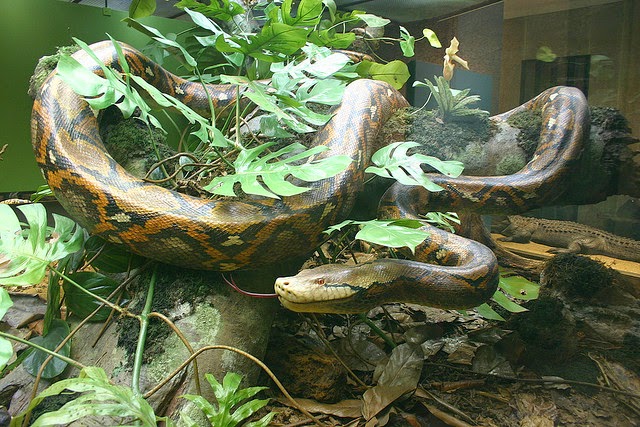
The latest additions to “creatures we thought reproduced sexually but turn out to be able to reproduce asexually” is a pretty spectacular one, because one of the two species is one of the biggest snakes in the world.

A paper published back in June by Booth and colleagues is suddenly making the rounds on news and social media. It describes research on two python species, the reticulated python (pictured, record holder for longest snake), and the royal python. While the news is focusing on “snake gives virgin birth!” angle, this paper is far more interesting.

The major question in this paper is: how do animals switch, genetically, from sexual to asexual reproduction? In most vertebrates - including the two in this paper - the answer is “terminal fusion automixis.”

In most female vertebrates, gametes divide unevenly in meiosis, with one large cell set to become the egg, and the other becoming a “polar body,” which normally dies. Some species are able to take the polar body and have it act like a sperm cell. The offspring that result are not genetically identical to their mother, because there is a a random element in meiosis.

There’s been one apparent exception: a Burmese python reproduced without sex, and the offspring were clones of the mother. If so, the offspring could not have been generated by terminal fusion automixis. This would be weird, given that this is out of step with an increasingly large number of cases.

Booth and colleagues, however, describe some unpublished data from another Burmese python laying eggs without sex. Here, the offspring are apparently not clones of the mother, which is in line with other species, but not the one previous account. Because of this, Booth and company suggest the previous paper be “viewed cautiously.”

This would be the normal translation from academese:


Booth and colleagues suggest that the first clone python report is not due to an error. Instead, they suggest that an individual, which had been created by parthenogentic reproduction, reproduced again by the same means. They write:

If this is indeed the case, this would represent the first documentation of such reproductive competence of (facultative parthenogensis) in vertebrates.

Only time (and a few more replications) will tell if there are indeed clone snakes. If there are, they seem to be rare.

Hat tip to Jason Goldman.

Reference

Booth W, Schuett GW, Ridgway A, Buxton DW, Castoe TA, Bastone G, Bennett C, McMahan W. 2014. New insights on facultative parthenogenesis in pythons. Biological Journal of the Linnean Society 112(3): 461–468. http://onlinelibrary.wiley.com/doi/10.1111/bij.12286/full

External links

Virgin Birth Discovered In The World's Largest Snake
Python babies the result of 'virgin birth,' zoo confirms


Photo by Ryan Somma on Flickr; used under a Creative Commons license. Graffiti picture from here.

22 December 2013

Going Grinch on Time

I should be happy that Marmorkrebs is getting attention in national media, namely Time magazine. Instead, my reaction is more like:


The annoyance starts with the title:

“Critters So Ugly They Have to Mate With Themselves”

It’s not the critters that are ugly, it’s the title. Time used to have a little more dignity, but this sounds like it came from Buzzfeed. How demeaning to call these animals “ugly,” especially when the list contains not just the pretty marbled crayfish, but the handsome Komodo dragon (which doesn’t always reproduce asexually, putting like to the “have to” portion of the title), the sleek whiptail lizard, and the amazing looking hammerhead shark (which, again, doesn’t always reproduce asexually). “Mate with themselves” suggests self-fertilization, which some animals do, but these are all cases of parthenogenesis rather than self-fertilization

The subtitle isn’t better.

Immaculate conception may be something special among humans, but in the animal kingdom, it's always been part of the mix

Science and religion are often depicted as being at war, but they are united in the desire for good fact checking. The immaculate conception is not about the virgin birth of Jesus Christ. It’s about the conception of the Jesus’s mother, Mary, free of original sin.

I’m reminded of this anecdote from Christopher Hitchens:

I made a mistake with one guy on a radio station in Seattle. I said I don’t think anyone really believes in the virgin birth and he said ‘I do.’ I said ‘you don’t really’ and he said, ‘I do, I believe absolutely in the immaculate conception.’ I told him he’d got it wrong and he said ‘What do you mean I’ve got it wrong? I’ve been a Catholic all my life.’ The immaculate conception and the virgin birth are two different concepts. He didn’t get this, but he believed in both.

The article manages to squeeze in three alternate spellings for Marmorkrebs in an equal number of paragraphs: “marmorkrebs,” and “Marmokrebs” (sic), both in a capitalized version (preferred here on the blog, following the German practice of capitalizing all nouns) and not.

And to add insult, the article is illustrated with this:


It’s not even a picture of the right species! It’s Procambarus clarkii, the common Louisiana red swamp crayfish! There are no shortage of Marmorkrebs pictures for use on this website and elsewhere. Time, you could have emailed me.

On the plus side, article does a nice job of linking to full text of the original scientific articles. And the actual text of the article, though short, is otherwise accurate.

External links

Critters So Ugly They Have to Mate With Themselves

18 December 2013

Human parthenogenesis, according to pregnant women

Christmas is the best time of the year to tell people about parthenogenesis, seeing that a story of human parthenogenesis forms a large part of Christmas tradition.

The British Medical Journal (or BMJ) has a new paper out that looks closely at reports of parthenogenesis in humans. According to Herring and colleagues, of over 7,000 young women (about 12-18) surveyed, about 0.8% of women reported pregnancy before they reported having sex.

As far as I can tell, they did not ask the women outright if they believed they got pregnant without the help of a man. They just extrapolated from whether women reported having had sex, whether they reported being pregnant, and comparing the dates. However, it seems likely that the women might have claimed virgin birth, given this interesting fact:

The virgins who reported pregnancies were more likely to have pledged chastity (30.5%) than the non-virgins who reported pregnancies (15.0%, P=0.01) or the other virgins (21.2%, P=0.007).

Also of note:

The virgins who reported pregnancy... were less likely to know how to use condoms than the non-virgins who reported pregnancy (79.6%, P=0.002).

The discussion mentions another fascinating group: the “born again virgins,” who reported having had sex early in the study, but reported themselves as virgins when surveyed again. This is actually much more common than virgin birth, accounting for about 3% of the women surveyed. This might be almost as miraculous as virgin birth.

I think there may be a few issues with self-reporting in this data set.

In addition to the interesting data, this paper also gets high points from me for referencing a Doctor Who episode in the introduction.

Reference

Herring AH, Attard SM, Gordon-Larsen P, Joyner WH, Halpern CT. 2013. Like a virgin (mother): analysis of data from a longitudinal, US population representative sample survey. BMJ 347 http://dx.doi.org/10.1136/bmj.f7102

Related post

Human parthenogenesis?

External links

Claims of virgin births in U.S. near 1 percent: study
Christmas Miracle? One In 200 US Pregnancies Reportedly Involve Virgin Mothers

Top image from here.

06 August 2013

Parthenogenesis primer

The Raptor Lab has a nice primer on parthenogenesis, although it focuses only on the phenomenon in pit vipers.

As if we required further proof life is weird, in walks parthenogenesis, an evolutionarily fascinating and frightening reproductive strategy, serving another round.