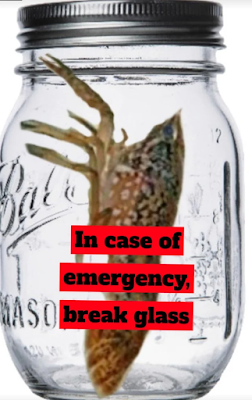
From Bluesky user charlie comes these art pieces of four invasive species, with Marmorkrebs in the middle:


The other three invasives are apple snails, round gobies, and European water chestnut plants.

From Bluesky user charlie comes these art pieces of four invasive species, with Marmorkrebs in the middle:
The other three invasives are apple snails, round gobies, and European water chestnut plants.

India Today has a nice little feature on animals that reproduce asexually. I am a little disappointed that marbled crayfish only come in at the middle of the list, but the photo they used is nice.
There’s been an uptick in my Google Alerts because of a new article about Marmorkrebs on SyFy Wire.
At first, I though the article was recycled from the big burst of coverage when the marbled crayfish genome was sequenced. A good chunk of the article discusses the 2018 paper, and it uses a press photo that came out at that time.
But as I saw back in 2018, when one popular news site does a story, many more will pick it up.
Update, 6 July 2022: Ths story got picked up on Yahoo! News. Good time for me to talk about the misleading title.
The title - “Cloned crayfish accidentally created in an aquarium are conquering the world” suggests people were actively mucking about with crayfish to accomplish something. No evidence of that.
There is zero evidence marbled crayfish were “created” in an aquarium. Again, it suggests human involvement when there was almost certainly none. Triploid (but maybe not reproductive) individuals of the sexual ancestor exist in wild. Early Marmorkrebs may have been collected from the wild and only later got a foothold in the aquarium trade,
External links
Cloned crayfish accidentally created in an aquarium are conquering the world
I stumbled across a page with a coloring book style blank illustration of Marmorkrebs! While the page says it’s for kids, there’sa a lot of fine detail that makes me think some young ones may find it a little on the high end of the difficulty scale.

The shape of the claws looks much more like Louisiana red swamp crayfish than Marmorkrebs, though.

The Cincinatti Enquirer answers a question I’ve been wondering for a while.
Some years ago, I noted the Cincinatti Zoo had a display of “Marbled crayfish” and listed them as Procambarus fallax. The zoo’s description mentioned nothing about asexual reproduction, so I thought they were slough crayfish from Florida or Georgia.
But a new article about the zoo says:
This baby marbled crayfish resembles a small lobster, but it will only grow to 2 to 3 inches long. All marbled crayfish are women. They don't need a partner to reproduce.
Marmorkrebs they are, then! Which makes me wonder why their reproduction wasn’t mentioned on the display.
Related posts
External links
Up close with the Cincinnati Zoo's most adorable ambassadors

“Stowaways” appears in the February 2021 issue of Harper’s magazine. It’s a feature-length examination of the invasion of Marmorkrebs on Madagascar. It was prompted by conversation with Julia Jones and was almost two years in the making.
There is some science, but the bulk of the article is a nuanced, detailed examination of the complexities of living with environmental change.
Over and over again, people are ambivalent to Marmorkrebs. People recognize the crayfish is a pest... but it’s a cheap meal. In a place where most people are living on the equivalant of a couple of US dollars a day, that matters.
In the hills above town, where rice cultivation depends on rainfall for irrigation, farmers complain that the levees of their terraced paddies spring leaks without warning, sparking arguments when valuable rainwater drains into their neighbors’ fields instead. Most realize that crayfish burrows are to blame, but suspicions linger all the same. “The tsi pe’peo is an enemy of agriculture,” Ramandrosoa told me. Nevertheless, he hesitated to advocate for its eradication. For families without even enough money to pay their children’s school fees, he said, “It’s kerosene, it’s sugar, it’s soap. It’s the basic necessities.” In the lean months, Ramandrosoa explained, “People collect crayfish so they don’t have to sell their rice.”
I also love the illustrations by Barry Falls. Look at this gem:

I will probably be rereading this many times. It’s a rich and insightful part of a story that I know from the published literature, but this shows just how little of the story makes it into journal articles.
Highly recommended.
External links
Gerety RM. 2021. Stowaways. Harper’s 342(2049): 72-79. https://harpers.org/archive/2021/02/stowaways-crayfish-madagascar/

Batches of Marmorkrebs were raised in nearly identical environmental conditions, yet they differed widely. Some were 20 times bigger than others. Some lived twice as long. Their behaviour was totally different. The tiny genetic and environmental differences made a huge difference in outcomes.


17 Marbled crayfish or marmorkrebs (Procambarus virginalis). It makes clones of itself from eggs unfertilised by sperm.
That the MC’ has 3 chromosomes, because it had 3 chromosomes when the scientists, (or whoever claimed a speciation occurred), (Your buddies), went to the German village, collected some live MC’s, thereon the person ‘creating’ the sham event, did put baby MC’s into the tank with Slough Cray’s……
It is obvious that Wiki are driven by Evolutionists like yourself, and writing a paper on how your mates say the sham speciation event occurred, is of no consequence to the reality that: The MC was ‘Created” a very long time ago with 3 chromosomes to be capable of self replication, to help feed the people, the German Traders at the Village has already stated to the world, that they were trading the MC’ for generations, hence, the MC’ simply has, and always had 3 chromosomes….
And your “Manufactured” series of events, are simply a stab in the dark, because the MC’ was placed in the tank, and people like you, then Peddle the sales pitch……… That is the TRUTH is it not
 A new feature by Jordana Cepelewicz in Quanta Magazine starts off using marbled crayfish to make a point about variation:
In the 1990s, an army of clones invaded Germany. Within a decade, they had spread to Italy, Croatia, Slovakia, Hungary, Sweden, France, Japan and Madagascar — wreaking havoc in rivers and lakes, rice paddies and swamps; in waters warm and cold, acidic and basic. The culprits: six-inch-long, lobster-like creatures called marbled crayfish. ...Marmorkrebs are not the point of the article, but it’s nice to see them so prominent featured. It’s a nice example of how marbled crayfish can be used as a model for general biological problems.
New research on crayfish and scores of other organisms is revealing an important role for a third, often-overlooked source of variation and diversity — a surprising foundation for what makes us unique that begins in the first days of an embryo’s development: random, intrinsic noise.

Michael Blastland’s recent book, The Hidden Half, argues that much of the variation we see in the world around us is essentially mysterious. Mr Blastland’s opening example is the marmorkrebs, a kind of crayfish that reproduces parthenogenetically — that is, marmorkrebs lay eggs without mating and those eggs develop into clones of their mothers.
Place two clones into two identical fish tanks and feed them identical food. These genetically identical creatures raised in apparently identical environments produce genetically identical offspring who nevertheless vary dramatically in their size, form, lifespan, fecundity, and behaviour. Sometimes things turn out very differently for no reason that we can discern. We might as well call that reason “luck” as anything else.


NO JOKE! Obama signs executive order to ‘Safeguarding the nation from an INVASIVE SPECIES’

Obama has pushed through an act called “Safeguarding the Nation from the Impacts of Invasive Species.” The interesting thing about this presidential order (see full text below) is the legal wording of the document leaves a lot up for suspicion. The article was left purposely vague, it seems.
There are a few reasons for this. The first could be simply so the article can be interpreted for years to come. The second is a little more malicious and slightly terrifying. An invasive species in the document is vaguely defined as an organism that disrupts an ecosystem. Because of this, some are speculating that this last order of 2016 is meant to protect from alien invasions, and purposely set some guidelines for the next presidency.
It has been shown in the news that the government is getting closer to telling its people what is actually out in space. If the planet needs protection for these beings, it will make sense that they would be motivated to tell the people, and also motivated to write an article to set up pretenses to protect the Earth. This is only my opinion, but I hope that some of my readers will do some investigation. Something strange is happening within the government.


 The International Association for Astacology meeting was recently held in Spain, and a nice press release about the two major lines of research on Marmorkrebs: as an unwanted invasive, and as a wanted model organism. I draw similar comparisons in my own chapter.
- This North American species is reshaping ecosystems by killing fish or molluscs on the one hand, and on the other hand, is used for studies related to cancer thanks to their particular genetics.
- Researchers Pavel Kozák and Frank J. Lyko presented studies about this crustacean at the 21st International Symposium of Astacology.
The marble crayfish (Procamborus (sic) fallax) is a curious exotic species, as has been disclosed during the 21st International Symposium of Astacology, which takes place at the Royal Botanical CSIC Garden. Like the strange case of Dr. Jekyll and Mr. Hyde, it shows two sides: a positive, because thanks to their particular genetics, it is used for cancer-related studies; and the other less pleasant, because it is an invasive species that is ravaging different ecosystems.
Researchers Pavel Kozák from the Faculty of Fisheries and Protection of Waters of the University of South Bohemia in the Czech Republic, and Frank J. Lyko, from the Cancer Research Center of Heidelberg in Germany, are working on two projects related to marbled crayfish. They presented their studies on this species from the point of view of ecology and reproduction (Kozák) and genetics (Lyko).
According to the Czech researcher, his project initially focused on the impact of invasive species on native species of crayfish, but as the project continued, this deepened to include the interaction between this invasive species and their impact on other invasive species, such as amphibians or fish.
The researcher Kozák focuses on two significant events. “First, marbled crayfish are destroying fish, molluscs, and macroinvertebrates, and ultimately, it is reshaping the entire ecosystem. Second, this invasive species is more powerful than other larger species, thus refuting the claim that the larger species tend to be more aggressive.”
Meanwhile, the German researcher Frank J. Lyko notes that the genetics of marbled crayfish reproduction, i.e., the females create clones of themselves, “is a model species to implement our work on cancer, since there is only one genome to study, hence its importance for medical science.”
Devastating effects
However, Lyko coincides with his Czech colleague Kozák in the “devastating effects” of marbled crayfish, such as in Madagascar where they have destroyed almost all the habitat where they have been, before making the leap to other countries. The first crayfish in Europe were found in Germany in 1995, and by 2010, it was established in nature, especially Central Europe. In the short term, also has changed the habitat of this area.
The two researchers also agree that, given that its eradication is impossible, citizens of the areas where this species is found be educated to know how easily it reproduces and the consequences of their invasion. They also requested legislation regulating the introduction of new species and greater control of ornamental trade, both in physical stores and the sale online, because it is very easy to get this species for aquariums, and their reproduction is immediate and unlimited.
Finally, for Czech researcher Pavel Kozák, this highlighted the work of the Royal Botanic Garden-CSIC of Madrid, which conducts research related to crayfish plague and supports students doing projects on astacology.