31 January 2012

Call for papers: 19th Freshwater Crayfish Symposium

The 19th International Symposium on Freshwater Crayfish (IAA19) is now accepting registrations and presentation abstracts. The meeting will be held in Innsbruck, Austria, at the University of Innsbruck from 26-31 August 2012.

Please note that discounted meeting registration fees (€30) are only for active members of the International Association of Astacology (IAA). So if you’re not a member, or have not renewed your membership, now’s the time to pay up!

Go to the meeting website at: http://www.uibk.ac.at/ecology/events/iaa19/index.html.en

24 January 2012

The eight most popular crayfish

Those keeping crayfish as pets might be interested in Chris Lukhaup’s round-up, Freshwater Aquarium Crayfish.

sciseekclaimtoken-4f1c31db78655

12 January 2012

Motto

Anyone need a new desktop wallpaper?


Rough translation: “My army of marbled crayfish will be invincible.”

28 December 2011

2011 was not the best year ever for Marmorkrebs research

If last year could be seen as a breakout year for Marmorkrebs research, this one might be counted as a correction.


As anyone who’s studied statistics should know, an extraordinary event is more likely to be followed by a rather more ordinary one. I am hoping this is just a temporary dip for Marmorkrebs research, and that in 2012, the upward trend will resume. And on a personal note, I look forward to carrying out the research funded by #SciFund in 2012!

In the larger crustacean realm, probably one of the most noteworthy news stories of the year was the publication of the first crustacean genome. But I keep wondering every time I hear about the advances of high throughput sequencing and how cheap and easy it’s getting... why don’t I have a crayfish genome yet? Grumble grumble grumble.

20 December 2011

New Freshwater Crayfish

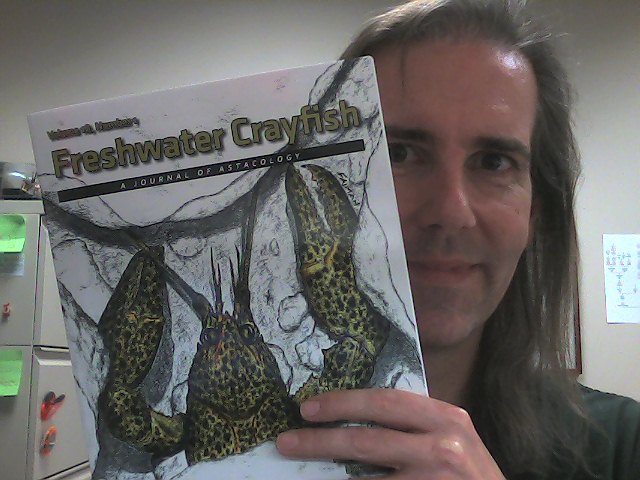
I got the hardcopy of the newest issue of Freshwater Crayfish last week. It’s the first part of volume 18. The production values are good, with sharp figure reproductions and gloss paper. There are some colour figures, too!

As I mentioned previously, the society International Association of Astacology really wants to have a push to get the journal published much more regularly. It used to be published only in alternate years. The society hopes that this will allow Freshwater Crayfish to be indexed in services like ISI Web of Science, which would mean that the journal could get an official Impact Factor.

Manuscripts for Freshwater Crayfish are now being accepted continually. The turnaround time from submission to publication should be on the order of months, rather than years. Submissions can uploaded to: http://iz.carnegiemnh.org/FCEditor/

Disclosure: I have an article in this issue, though not on Marmorkrebs.

Hippler and colleagues, 2011

Hippler D, Hu N, Steiner M, Scholtz G, Franz G. 2011. Experimental mineralization of crustacean eggs leads to surprising tissue conservation: new implications for the fossilization of Precambrian-Cambrian embryos. Biogeosciences Discussions 8: 12051-12077. http://dx.doi.org/10.5194/bgd-8-12051-2011

Abstract

Phosphatized globular microfossils from the Ediacaran and Lower Cambrian of South China represent an impressive record of early animal evolution and development, however their affinity based on putative embryonic metazoan, bacterial and inorganic features is strongly debated. Understanding key processes and conditions that cause exceptional egg and embryo preservation and fossilization are therefore crucial for a reliable interpretation of their phylogenetic position. Taphonomic experiments on eggs of the marbled crayfish indicate a close link between early mineralization and rapid anaerobic decay of the endochorional envelope, producing different preservational stages of degradation resembling the various decay stages observed in the fossil record. Stabilization of the spherical morphology was achieved by pre-heating of the eggs. Complete surface mineralization occurred under reduced conditions within one to two weeks, with fine-grained brushite (CaHPO4·2H2O) over calcite as the dominating mineral phase. Although the endochorional envelope was not preserved, experiments resulted in exceptional preservation of the embryonic tissue at the cellular level. Thus our findings suggest that the mechanisms of decay, preservation of surface structures, and mineral replacement in the experiment and during fossilization of Cambrian embryos were likely operating at a similar rationale.

Keywords: None provided.

Note: This discussion paper is under review for the journal Biogeosciences. This journal has an editorial policy that differs from many other journals, described as “innovative two-stage publication process with Public Peer-Review & Interactive Public Discussion.” The paper is initially published – permanently archived – in Biogeosciences Discussions, to receive comments (which are also archived). If the paper is accepted by the editors of Biogeosciences, the final version appears in that journal as the “copy of record.” If not, the paper remains in Biogeosciences Discussions, does not contribute to the Biogeosciences’ Impact Factor, etc.

15 December 2011

#SciDone!

And there’s the siren! The #SciFund challenge has came to an end! Here are some of my initial reactions to the experience.

Things that I didn’t expect:

Fewer people, bigger donations. I thought most donations would be small – a dollar or two – and projects would have hundreds of supporters. Instead, projects had tens of supporters contributing $10-20, and more, often much more. Consequently,  my “I make my target if everyone chips in 50 cents” pitch to my several thousand followers on Twitter and Google Plus wasn’t effective.

Traditional media still rules. The break out success story was, without a doubt, Kristina Kilgrove’s Roman DNA project. There’s no doubt that it made it because it was on the CNN website.

Cool beats practical: Given how much talk there is on how people want to see “results” and “return on investment” in traditional funding, my one post where I described how my research might have a practical pay-off to aquaculture got the least hits of anything I did to promote my project over six weeks.

Weak relationship between video views and dollars. “Duck force” got more than ten times the views of my video, but it didn’t get ten times the donations.

Front end loaded: I expected most funds to come in at the very beginning and the very end. RocketHub confirmed that this is the normal pattern. But the “bump” in the last few days was much smaller than I expected. On my project, the amount of dollars raised and time elapsed were pretty tightly correlated.

So emotional: I touched on this before here. I got way more wrapped up in this tiny little fundraising effort than most other projects.

Not much variation. Most projects raised about the same amount, regardless of their targets. $1,000 or so seems to be the sweet spot for now.

I made the right call to keep my project target small. At one point, I almost raised it, and if I had, I don’t think I would have made it. Projects that want to raise ten grand are either going to have to be brilliant or wait for the crowdfunding of science to mature.

Things that disappointed me:

Notice us! We didn’t get as much attention from science media as I expected. No coverage in the Science, Nature, The Guardian, The New York Times, Quirks and Quarks, and so on.

Whiff: Thirty-nine projects didn’t meet their targets.

Low gear: I was hoping to be one of the first projects to get past the post. I though that I would have a good shot at it, based on responses of people to whom I showed my video, and that I had one of the lowest targets.

Left undone: I had ideas for three more videos that I didn’t get to make.

Things that made me happy:

Mad skills: I learned a lot about how to make short videos. I may be doing more.

Total: Over $75,000 for science!

Hits! Ten projects met their targets.

This time, it’s personal: And one of them was mine.

If #SciFund were to go again:

I would say: Yes. Even though it’s inefficient, it’s fun. And as I noted, I’m unlikely to walk away completely empty-handed, which is usually what I get for writing big grant applications.

Stay home: I would try not to go to the biggest scientific meeting in the world for a week. I felt I lost quite a bit of momentum because of that.

More focus: Not my call, but at first we had over 200 people express interest in doing this. We ended up with 49 live projects. I wonder if even that was spreading attention too thin.

There will be much more analysis of the #SciFund challenge in the days and months to come. It was a social experiment, and we are all scientists, after all. But for now, this is...


Photo by viking_79 on Flickr; used under a Creative Commons license.