24 February 2022

Sentis and colleagues 2022

Cover of journal Ecology and Evolution

Sentis A, Veselý L, Let M, Musil M, Malinovska V, Kouba A. 2022. Short-term thermal acclimation modulates predator functional response. Ecology and Evolution 12(2): e8631. https://doi.org/10.1002/ece3.8631


Abstract


Phenotypic plastic responses to temperature can modulate the kinetic effects of temperature on biological rates and traits and thus play an important role for species adaptation to climate change. However, there is little information on how these plastic responses to temperature can influence trophic interactions. Here, we conducted an experiment using marbled crayfish and their water louse prey to investigate how short-term thermal acclimation at two temperatures (16 and 24°C) modulates the predator functional response. We found that both functional response parameters (search rate and handling time) differed between the two experimental temperatures. However, the sign and magnitudes of these differences strongly depended on acclimation time. Acclimation to 16°C increased handling time and search rate whereas acclimation to 24°C leads to the opposite effects with shorter handling time and lower search rate for acclimated predators. Moreover, the strength of these effects increased with acclimation time so that the differences in search rate and handing time between the two temperatures were reversed between the treatment without acclimation and after 24 h of acclimation. Overall, we found that the magnitude of the acclimation effects can be as strong as the direct kinetic effects of temperature. Our study highlights the importance of taking into account short-term thermal plasticity to improve our understanding of the potential consequences of global warming on species interactions.


Keywords: None provided.

 

Open access


11 February 2022

Kaliszewicz and colleagues, 2022

The European Zoological Journal cover

Kaliszewicz A, Karaban K, Sierakowski M, Maciaszek R, Kur M, Pyffel Z, Wolny L, Chmiel K, Łuciuk P, Rusin P, Kowalczyk K. 2022. Effect of dietary supplementation with fatty acids on growth, survival, and fatty acid patterns in Procambarus clarkii and Procambarus virginalis: the first comparison of two invasive crayfish species. The European Zoological Journal 89(1): 123-134. https://doi.org/10.1080/24750263.2022.2030420


Abstract


The red swamp crayfish, Procambarus clarkii, and the marbled crayfish, Procambarus virginalis, are invasive species expanding their ranges on a global scale. Their spread is favored by the fact that these crayfish are also aquaculture species of great economic importance (P. clarkii) or promising prospects in this regard (P. virginalis). This study represents the first attempt to assess the impact of diet supplementation with fatty acids on growth, survival, and fatty acid content in these crayfish species, as well as the first record of fatty acid patterns in the obligate parthenogenetic marbled crayfish. Our results showed that supplementation with saturated palmitic acid increased P. clarkii survival, which has not previously been reported for crustaceans. This positive effect on the part of palmitic acid supplementation was not observed for P. virginalis individuals. Marbled crayfish had significantly higher survival rates than red swamp crayfish regardless of the diet used. The growth of both species was not affected by fatty acid supplementation. Our study indicated that young marbled crayfish had a poorer fatty acid profile than juvenile conspecifics and red swamp crayfish. Fatty acid supplementation and type of diet significantly affected the fatty acid composition in the crayfish tissues. There was an increase in unsaturated α-linolenic acid for P. clarkii and palmitic acid for P. virginalis. Palmitic acid quantitatively dominated in both species regardless of the experimental treatment, with the exception of juvenile P. virginalis, which was fed an oligochaete diet rich in EPA. 


Keywords: red swamp crayfish • marbled crayfish • diet supplementation • saturated fatty acids

05 February 2022

Vogt 2022

The Science of Nature cover

Vogt G. 2022. Studying phenotypic variation and DNA methylation across development, ecology and evolution in the clonal marbled crayfish: a paradigm for investigating epigenotype-phenotype relationships in macro-invertebrates. The Science of Nature 109(1): 16. https://doi.org/10.1007/s00114-021-01782-6


Abstract


Animals can produce different phenotypes from the same genome during development, environmental adaptation and evolution, which is mediated by epigenetic mechanisms including DNA methylation. The obligatory parthenogenetic marbled crayfish, Procambarus virginalis, whose genome and methylome are fully established, proved very suitable to study this issue in detail. Comparison between developmental stages and DNA methylation revealed low expression of Dnmt methylation and Tet demethylation enzymes from the spawned oocyte to the 256 cell embryo and considerably increased expression thereafter. The global 5-methylcytosine level was 2.78% at mid-embryonic development and decreased slightly to 2.41% in 2-year-old adults. Genetically identical clutch-mates raised in the same uniform laboratory setting showed broad variation in morphological, behavioural and life history traits and differences in DNA methylation. The invasion of diverse habitats in tropical to cold-temperate biomes in the last 20 years by the marbled crayfish was associated with the expression of significantly different phenotypic traits and DNA methylation patterns, despite extremely low genetic variation on the whole genome scale, suggesting the establishment of epigenetic ecotypes. The evolution of marbled crayfish from its parent species Procambarus fallax by autotriploidy a few decades ago was accompanied by a significant increase in body size, fertility and life span, a 20% reduction of global DNA methylation and alteration of methylation in hundreds of genes, suggesting that epigenetic mechanisms were involved in speciation and fitness enhancement. The combined analysis of phenotypic traits and DNA methylation across multiple biological contexts in the laboratory and field in marbled crayfish may serve as a blueprint for uncovering the role of epigenetic mechanisms in shaping of phenotypes in macro-invertebrates.


Keywords: phenotype • development • DNA methylation • ecology • evolution • marbled crayfish

18 January 2022

Marmorkrebs feature in The Guardian

The Guardian
Kate Connolly has written a substantive summary of the state of Marmorkrebs in The Guardian that includes new interviews with several researchers.


The article also prompted some coversation on Twitter about how likely it is that crayfish can help regulate schistosomiasis.


I think my favourite part of the article is a previously undescribed pattern of behaviour: that they are nocturnal:


Lyko recalls driving to a lake about 15 minutes from his lab with his students. Donning head torches and waders and standing ankle deep in the water, “we waited until it got dark, then suddenly they emerged in their hundreds and thousands”, he says.


Recommended!


External links


‘We started eating them’: what do you do with an invasive army of crayfish clones?

Marmorkrebs in Canada?

Crayfish
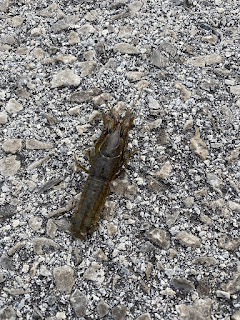
Premek Hamr drew attention to this record on iN today: a potential Marmorkrebs sighting in City View Park, Burlington, Ontario.


Guenter Schuster suspects that it might be Procambarus, but keying out to species from these pictures is effectively impossible.


That said, local park in an urban environment has been almost exactly the most common pattern we have seen in other locations: someone with an aquarium dumps some unwanted animals into a local park.


This was last October – mere months before Ontario banned Marmorkrebs at the start of 2022. Although Marmorkrebs have done well in some northern locations, it’s hard to tell if they could overwinter in Canada.


Has our luck finally run out? Is this the thin end of the wedge that will be the start of many more invasions of North America?


External links


Marbled crayfish on iNaturalist


https://twitter.com/DrCrayfish/status/1483449536873996291


https://twitter.com/crayfishguenter/status/1483465069560270848 


15 January 2022

Maiakovska, 2021

University of Heidelberg
Maiakovska O. 2021. Origination, monoclonality and evolution of the marbled crayfish genome Procambarus virginalis. Doctoral dissertation, The Faculty of Bio Sciences, Ruperto Carola University Heidelberg, Germany.
https://doi.org/10.11588/heidok.00029661


Abstract


The parthenogenetic marbled crayfish (Procambarus virginalis) sparked interest within the scientific community due to its unique features. Its polyploid and monoclonal genome, high environmental adaptability and phenotypic diversity made the marbled crayfish a suitable laboratory model for genomics, epigenetics and ecology research. The previously established marbled crayfish genome sequence of 3.5 Gbp represents a highly fragmented draft assembly. Initial comparative genomic analyses resulted in confirmation of P. virginalis genome origination from the sexually reproducing freshwater crayfish P. fallax. However, in-depth genomic analysis and interspecies genome comparisons require further refinement of the fragmented genome reference of the marbled crayfish. In this PhD thesis, the first refinement of the marbled crayfish genome has been performed with application of the PacBio Single Molecule Real Time (SMRT) sequencing technology. The new and improved genome assembly of the marbled crayfish resulted in 3.7 Gbp of sequence length and an N50 of 144kb. The refined genome assembly enabled searching parental haplotypes and understanding species origination. The absence of evidence for loss of heterozygosity in the various monoclonal marbled crayfish generations suggests the lack of recombination process during oogenesis. Thus, marbled crayfish suggest to be apomictic parthenogens which are characterized by generating identical copies of the maternal genotype. Moreover, despite of the limited genome variability, monoclonal marbled crayfish genomes consisted of population-specific genetic polymorphisms within the global population. Comparative genomic analysis between geographically distant populations resulted in the identification of population-specific mutational signatures. The calculation of genomic variability of marbled crayfish from the growing population in Lake Reilingen allowed to estimate population dynamics. Thus, the population in Lake Reilingen demonstrates a rapid growth, following the density-independent exponential model. This PhD thesis provides fundamental insights into marbled crayfish research, particularly via making use of an improved genome assembly for comparative genomic analyses, epigenetic studies, and for research on the evolution and genomic adaptation to asexuality.


Keywords: None provided.

14 January 2022

Tŏnges, 2021

University of Heidelberg logo

Tönges SM. 2021. Context-dependent DNA methylation variants in marbled crayfish (Procambarus virginalis). Doctoral dissertation, The Faculty of Bio Sciences, Ruperto Carola University Heidelberg, Germany. https://doi.org/10.11588/heidok.00029299


Abstract


The marbled crayfish is a recently discovered freshwater crayfish. It is the only known decapod crustacean that reproduces by obligate apomictic parthenogenesis resulting in a clonal, all-female population. All known marbled crayfish have a single origin, and the species is estimated to have an age of about 25-30 years. Furthermore, it has spread already into several countries globally and shows high adaptability to different environments in the absence of genetic adaptation. Epigenetic mechanisms were suggested to play a role in the rapid adaptation of this species. This thesis aims to identify context-dependent DNA methylation variants in marbled crayfish. Samples from two tissues and four distinct habitats were analyzed with a capture-based bisulfite sequencing approach to identify methylation variants. The results were validated by deep amplicon sequencing of tissue-specific and location-specific regions and with newly collected samples from the same tissues and locations as before. The location-specific methylation patterns suggest the existence of epigenetic ecotypes and allow the tracing of the origin of marbled crayfish populations by their DNA methylation fingerprint. In a laboratory trial, single rearing conditions were changed to see the influence of specific parameters on the methylation pattern. Within six months, methylation changes could be observed for the group kept at a lower temperature compared to the control group, indicating the adaptation of the methylation pattern caused by an environmental trigger. Furthermore, the laboratory population showed a different methylation pattern compared to the wild populations. Lastly, the potential of marbled crayfish as an aquaculture livestock was explored, and a framework for an environmentally safe aquaculture was established. Additionally, tracing the origin of marbled crayfish using location-specific methylation patterns was proposed for certifying sustainable and transparent aquaculture practices. These re-sults provide insight into the rapid adaptation in invasive species and provide a proof of concept for environmental origin tracing with DNA methylation fingerprinting.


Keywords: Epigenetics • ecology • aquaculture


Open access