 NeuronBank
is a project I have been offering moral support to, mainly in the form of links here and there around the Marmorkrebs websites I run. The goal of NeuronBank is to compile the "neurome" for organisms, mainly invertebrates.
Most people are familiar with the concept of a genome: the sum total of all the genes in an organism. Since the success of the Human Genome Project, other "-ome" projects have been slowly creeping into scientific awareness. Arguably proteomics is one of the most common new -omes in the scientific news. Neuromes -- a description of all neurons in an animal -- are not in that league yet, but that may start to change.
A forthcoming new review by Lichtman and Sanes in
Current Opinion in Neurobiology goes one step further, discussing not only neuromes, but connectomes: a description of not only all the neurons in a nervous system, but their anatomical and physiological connections, too.
If that sounds difficult, it is, but it's already been done in one animal: the little nematode worm
C. elegans. The
C. elegans project is discussed in some detail -- which it has to be, seeing how it's the only animal in the connections between all 302 neurons in the wild-type animal has been described.
While there is no complete neurome or connectome for a crustacean, there are neuromes and connectomes for
parts of crustacean nervous systems. The stomatogastric ganglion in several species has about 30 neurons, and
all the neurons and all the connections in the stomatogastric ganglion are known for some crabs and lobsters, thanks largely to work in Allen Selverston's lab. This has led to a massive amount of research on the stomatogastric ganglion. Literally entire books have been written on the subject (Harris-Warrick, 1992; a PDF of the first chapter is available
here).
The crustacean cardiac ganglion, which usually has 9 neurons, may also have a complete circuit worked out for it, though I have been unable to confirm this in writing this post. In any case, it is well characterized (Cook, 2002).
But are other parts of the crustacean nervous system amenable to compiling a even a partial neurome, never mind a connectome? I think so, and suggest crayfish abdominal ganglia are ripe for creating a neurome.
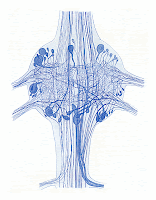
The tail of a crayfish contains six clusters of nerve cells (a.k.a. ganglia). The first five from the front are very similar, and only the very last one, the terminal abdominal ganglion, is substantially different than the others. The abdominal ganglia of crayfish are widely used for electrophysiology, because the dissection is very simple. Wine (1984) estimated that there are about 650 neurons in each of the first five abdominal ganglia.
650 is not that big a number of neurons. And a reasonable number of them are already described. Given a few dedicated labs, creating a neurome for these ganglia seems at least feasible.
In
one of my earliest posts on this blog: Every major model organism has earned that rank on the back of a massive descriptive project. I've
already said there should be a crayfish genome project; a crayfish neurome project should be in the works, too.
ReferencesCooke IM. 2002. Reliable, responsive pacemaking and pattern generation with minimal cell numbers: the crustacean cardiac ganglion.
The Biological Bulletin 202: 108-136.
http://www.biolbull.org/cgi/content/full/202/2/108Harris-Warrick RM, Marder E, Selverston AI, Moulins M (eds.). 1992.
Dynamic Biological Networks: The Stomatogastric Nervous System. Cambridge: MIT Press.
Lichtman JW & Sanes JR. 2008. Ome sweet ome: what can the genome tell us about the connectome?
Current Opinion in Neurobiology: In press.
http://dx.doi.org/10.1016/j.conb.2008.08.010Wine JJ. 1984. The structural basis of an innate behavioural pattern.
The Journal of Experimental Biology 112: 283-319.
http://jeb.biologists.org/cgi/content/abstract/112/1/283


