04 December 2014

Keller and colleagues, 2014

Keller NS, Pfeiffer M, Roessink I, Schulz R, Schrimpf A. 2014. First evidence of crayfish plague agent in populations of the marbled crayfish (Procambarus fallax forma virginalis). Knowledge and Management of Aquatic Ecosystems 15: 8. http://dx.doi.org/10.1051/kmae/2014032

Abstract

The introduction of non-indigenous species and associated diseases can cause declines in indigenous flora and fauna and threaten local biodiversity. The crayfish plague pathogen (Aphanomyces astaci), carried and transmitted by latent infected North American crayfish, can lead to high mortalities in indigenous European crayfish populations. Although the parthenogenetic marbled crayfish (Procambarus fallax (Hagen, 1870) forma virginalis) is common in the aquarium trade and has established wild populations in Europe, its carrier status is still unknown. This study investigated one captive and three established wild-living marbled crayfish populations for an infection with the crayfish plague pathogen applying real-time PCR. We demonstrate that captive, as well as two wild marbled crayfish populations were infected by A. astaci. Although infection status in laboratory kept specimens reached high levels, marbled crayfish showed no obviously plague-related mortality. Furthermore, sequence analysis revealed that captive crayfish carried the A. astaci genotype Pc, which has earlier been isolated from the North American red swamp crayfish (Procambarus clarkii). The results indicate that due to its positive carrier status marbled crayfish poses a greater threat to local biodiversity in Europe than considered until now.

Keywords: marbled crayfish • crayfish plague agent • exotic pathogen • invasive species • real-time PCR

02 December 2014

The colours, man, check out the colours...


These images I found on a Craigslist ad caught me attention as being a bit... brighter than most Marmorkrebs pictures I see.


I think there may be a little Instagram-style filtering going on...


19 November 2014

Patoka and colleagues, 2014

Patoka J, Kalous L, Kopecký O. 2014. Risk assessment of the crayfish pet trade based on data from the Czech Republic. Biological Invasions 16(12): 2489-2494. http://dx.doi.org/10.1007/s10530-014-0682-5

Abstract

The pet trade in freshwater crustaceans, including crayfish, has grown rapidly in recent decades and become an important pathway for introducing new non-indigenous species into Europe. This paper provides the first overview of non-indigenous crayfish species (NICS) traded as ornamental and their potential impact in the Czech Republic, which is the second leading importer into Europe. The paper presents a full list of traded crayfish species, their market availability, and trade names or misnomers used in the country. In total, 27 crayfish species from all three families are advertised and marketed, of which Astacus astacus is the only indigenous species. Only three NICS were recognized as very common on the market. The invasiveness and risk associated with ornamental crayfish trade were assessed using the Freshwater Invertebrate Invasiveness Scoring Kit. Five NICS were classified into the high-risk category, the highest score being for Procambarus fallax f. virginalis. The invasiveness of crayfish indigenous to North America is significantly greater than that of crayfish from the rest of the world, and therefore regulation in this regard is recommended.

Keywords: Ornamental animal • Invasiveness • FI-ISK • Aquarium • Trade names

Chucholl, 2014

Chucholl C. 2014. Predicting the risk of introduction and establishment of an exotic aquarium animal in Europe: insights from one decade of Marmorkrebs (Crustacea, Astacida, Cambaridae) releases. Management of Biological Invasions 5(4): 309-318. http://dx.doi.org/10.3391/mbi.2014.5.4.01

Abstract

The presence of the North American Marmorkrebs (Procambarus fallax f. virginalis) in European inland waters is entirely driven by ongoing propagule pressure from the ornamental trade. Since 2003 at least 25 independent introduction events have been confirmed, of which some have eventually resulted in established populations. This study links a maximum-entropy model that forecasts the probability of Marmorkrebs introduction based on socio-economic predictors to an updated species distribution model based on environmental predictors in order to explore the risk of further Marmorkrebs establishment in Europe. In line with related research, the probability of Marmorkrebs release was largely affected by gross domestic product and human population density, i.e. predictors very likely related to the density of Marmorkrebs owners, whereas environmental suitability was mostly influenced by minimum temperature and the availability of lentic habitats, which was indirectly assessed by terrain slope. While considerable parts of Europe were predicted as potentially suitable for establishment, high probabilities of introduction were forecasted in much smaller geographic areas. The consensus map of the model predictions suggests that introduction and subsequent establishment of Marmorkrebs is likely to occur in much of Germany, the Benelux countries, England, Italy, and areas of high human population density throughout France and Spain, as well as parts of southernmost Scandinavia and Southeastern Europe. Monitoring trades of Marmorkrebs in these high-risk regions is recommended and implications for proactive measures are discussed, including the need for consistent trade regulations at the EU level.

Keywords: marbled crayfish • propagule pressure • risk assessment • ornamental trade • introduction pathway

Celebrate diversity: Winning evolution without sex

Quanta magazine has a nice feature article on rotifers, which are apparently some of the longest running asexual lineages that we know about. Or maybe they’re not asexual... maybe it’s sex, Jim, but not as we know it:

The new work has shown bdelloids to be so good at generating genetic diversity that some researchers now question the very definition of sex, with some arguing for a more expansive one that doesn’t require the orchestrated swapping of genetic material. Others think that even if the traditional definition of sex remains intact, the unique genetic strategies of the bdelloid rotifer will illuminate the mechanisms that make sex such a successful evolutionary strategy.

11 November 2014

Vojkovská and colleagues, 2014


Vojkovská R, Horká I, Tricarico E, Duriš Z. 2014. New record of the parthenogenetic marbled crayfish Procambarus fallax f. virginalis from Italy. Crustaceana 87(11-12): 1386-1392. http://dx.doi.org/10.1163/15685403-00003365

Abstract

To date, the ‘marbled crayfish’, Procambarus fallax (Hagen, 1870) f. virginalis, in Italy has been reported only from Tuscany (central Italy). Recently, specimens of this alien American crayfish were found in the Po di Maistra Channel, Porto Tolle, south of Venice (northern Italy). The identification of this species was confirmed by its external morphology and colour pattern, as well as by molecular analysis. The present report provides the second record for the marbled crayfish in Italy.

Keywords: None provided.

28 October 2014

Celebrate diversity: Big babies

The latest additions to “creatures we thought reproduced sexually but turn out to be able to reproduce asexually” is a pretty spectacular one, because one of the two species is one of the biggest snakes in the world.

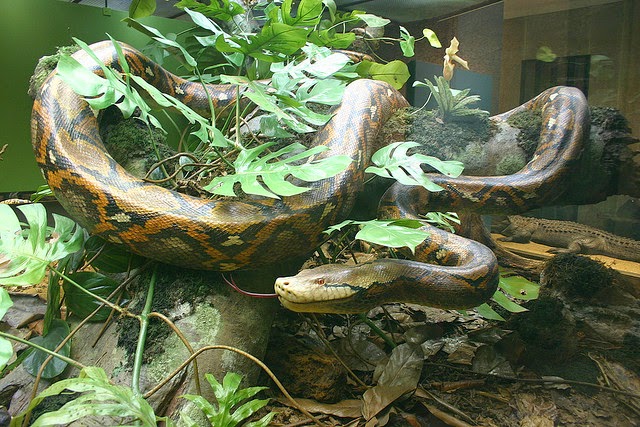
A paper published back in June by Booth and colleagues is suddenly making the rounds on news and social media. It describes research on two python species, the reticulated python (pictured, record holder for longest snake), and the royal python. While the news is focusing on “snake gives virgin birth!” angle, this paper is far more interesting.

The major question in this paper is: how do animals switch, genetically, from sexual to asexual reproduction? In most vertebrates - including the two in this paper - the answer is “terminal fusion automixis.”

In most female vertebrates, gametes divide unevenly in meiosis, with one large cell set to become the egg, and the other becoming a “polar body,” which normally dies. Some species are able to take the polar body and have it act like a sperm cell. The offspring that result are not genetically identical to their mother, because there is a a random element in meiosis.

There’s been one apparent exception: a Burmese python reproduced without sex, and the offspring were clones of the mother. If so, the offspring could not have been generated by terminal fusion automixis. This would be weird, given that this is out of step with an increasingly large number of cases.

Booth and colleagues, however, describe some unpublished data from another Burmese python laying eggs without sex. Here, the offspring are apparently not clones of the mother, which is in line with other species, but not the one previous account. Because of this, Booth and company suggest the previous paper be “viewed cautiously.”

This would be the normal translation from academese:


Booth and colleagues suggest that the first clone python report is not due to an error. Instead, they suggest that an individual, which had been created by parthenogentic reproduction, reproduced again by the same means. They write:

If this is indeed the case, this would represent the first documentation of such reproductive competence of (facultative parthenogensis) in vertebrates.

Only time (and a few more replications) will tell if there are indeed clone snakes. If there are, they seem to be rare.

Hat tip to Jason Goldman.

Reference

Booth W, Schuett GW, Ridgway A, Buxton DW, Castoe TA, Bastone G, Bennett C, McMahan W. 2014. New insights on facultative parthenogenesis in pythons. Biological Journal of the Linnean Society 112(3): 461–468. http://onlinelibrary.wiley.com/doi/10.1111/bij.12286/full

External links

Virgin Birth Discovered In The World's Largest Snake
Python babies the result of 'virgin birth,' zoo confirms


Photo by Ryan Somma on Flickr; used under a Creative Commons license. Graffiti picture from here.